4Support: Lower-Body Muscle Monitoring System
4Support
A wearable system developed to reduce injury risk and improve lower-body training confidence.
A wearable system developed to reduce injury risk and improve lower-body training confidence.
Overview
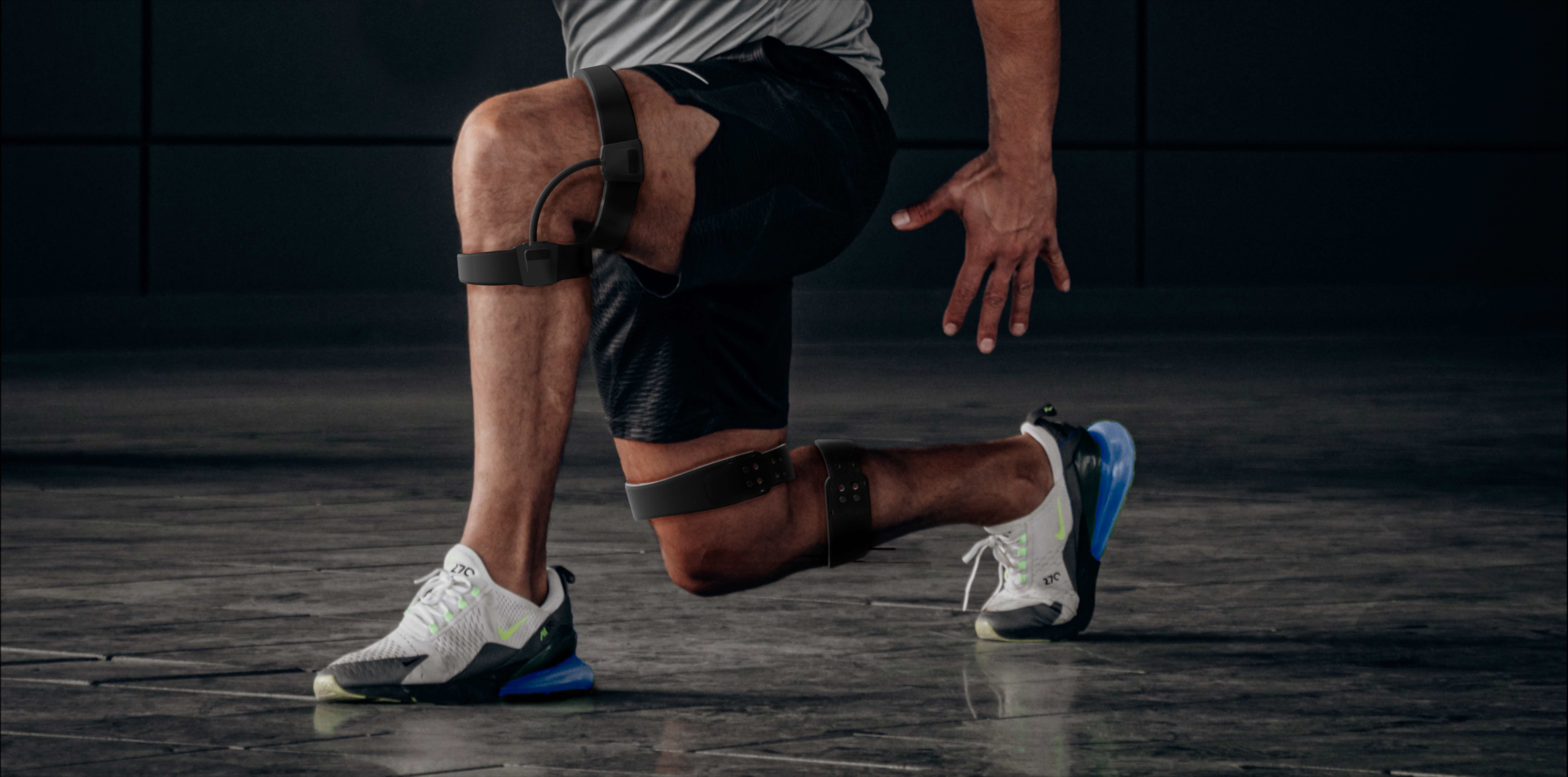
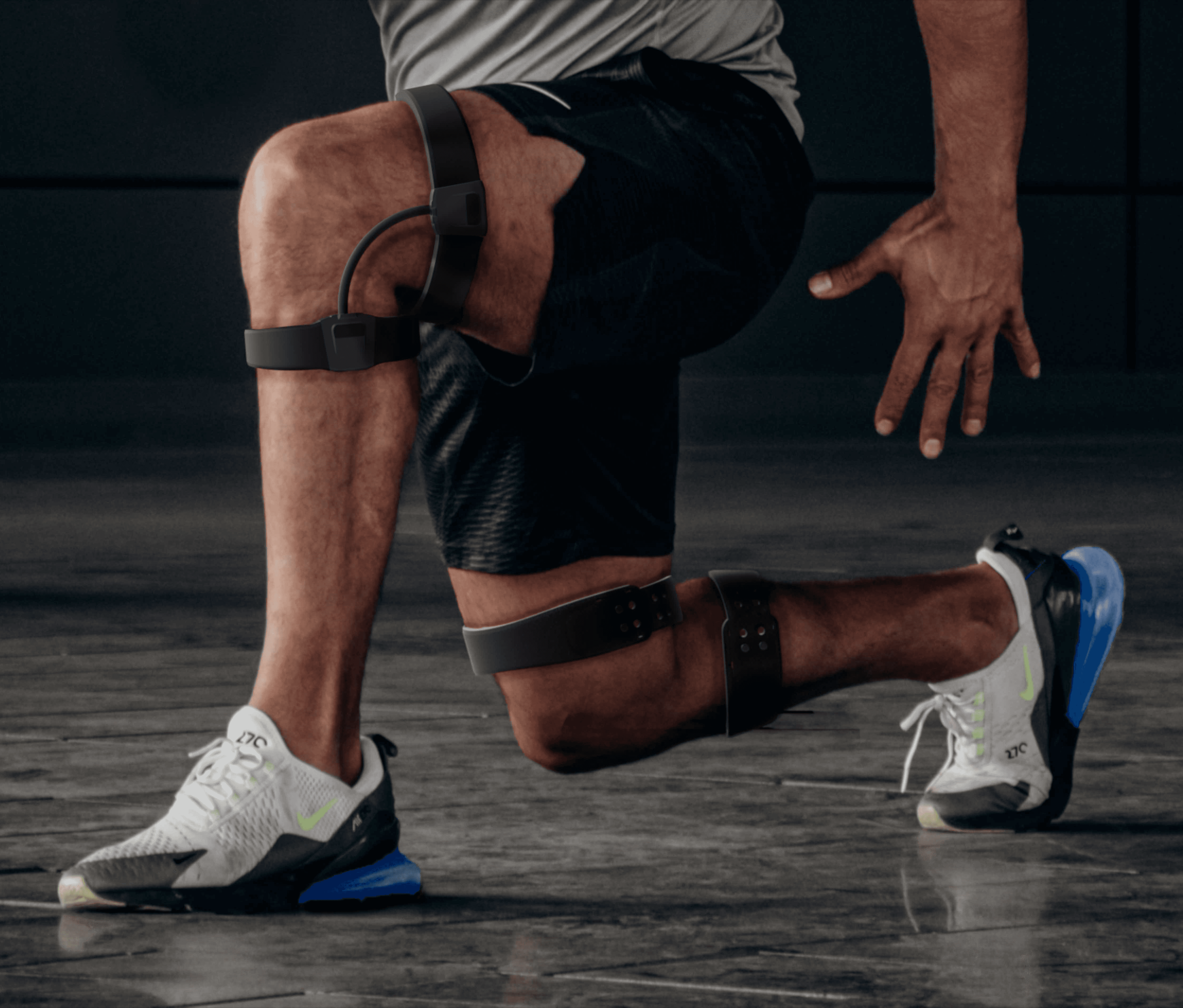
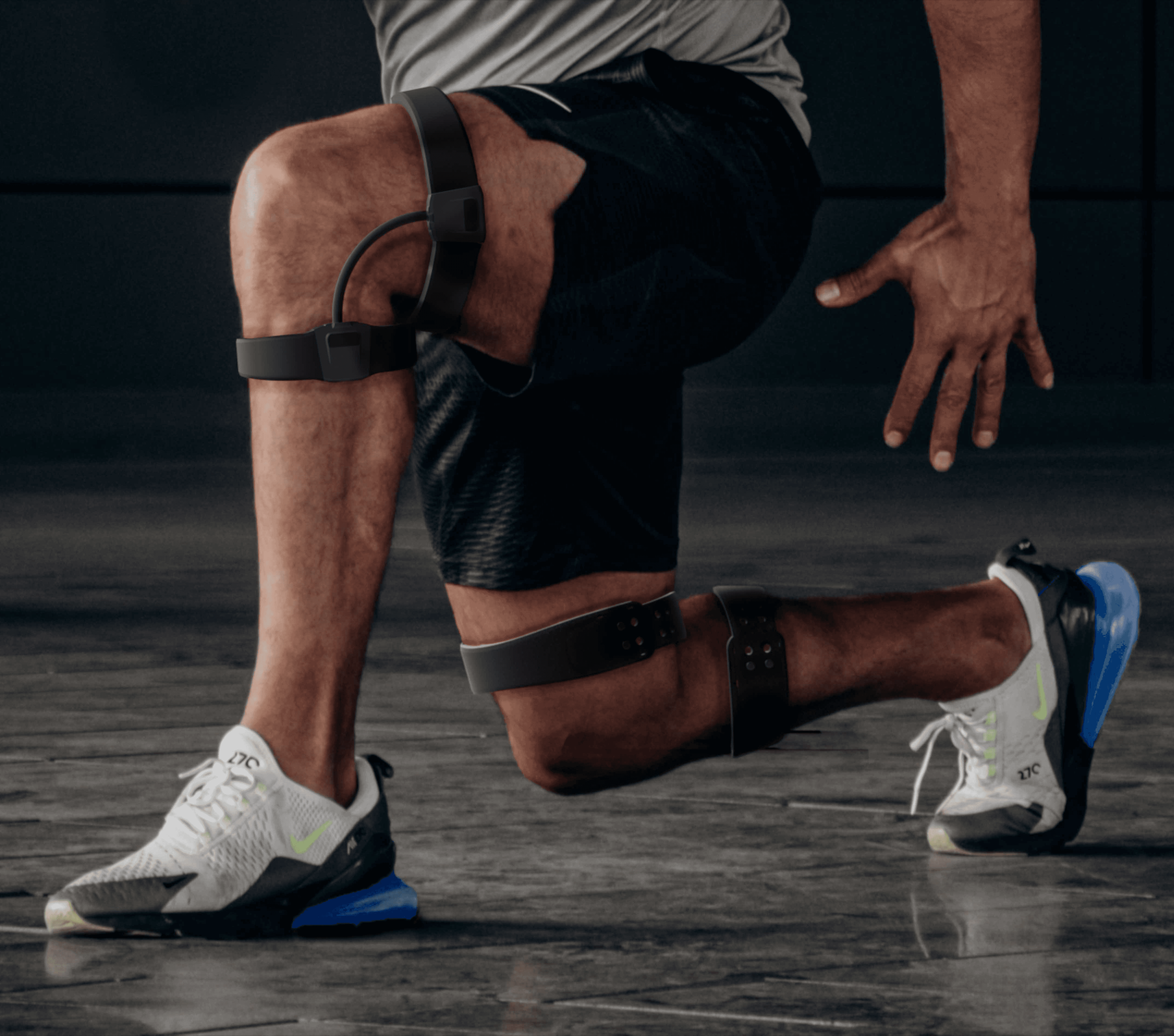
4Support is a wearable system developed to address one of the primary barriers to lifelong strength training: fear of injury.
Through the integration of sEMG and IMU sensors into ergonomic lower-body bands, the system monitors muscle activation and knee joint mechanics in real time. Data is transmitted to a connected mobile application that provides actionable feedback on form, fatigue, and muscular imbalances.
This project explores how wearable biomechanics technology can be applied to help adults train more safely, build confidence, and maintain long-term physical resilience.
4Support is a wearable system designed to reduce injury risk in strength training.
By combining sEMG and IMU sensors within ergonomic lower-body bands, the system monitors muscle activation and knee mechanics in real time. A connected app delivers feedback on form, fatigue, and imbalances to support safer, more confident training.
School
Carleton University
Carleton University
Launch
University Thesis Project
University Thesis Project
2022
2022
Role
Lead Industrial Designer
Lead Industrial Designer
Solo Project
Solo Project
Skill Focus
Human Factors
Biomechanics
Evidence-Based
Awards
2025 FIT Sport Design Awards
2025 FIT Sport Design Awards
Innovation, Strength Training, & Sports Gadget
Innovation, Strength Training, & Sports Gadget
Problem
Fear of injury becomes the barrier to lifelong strength
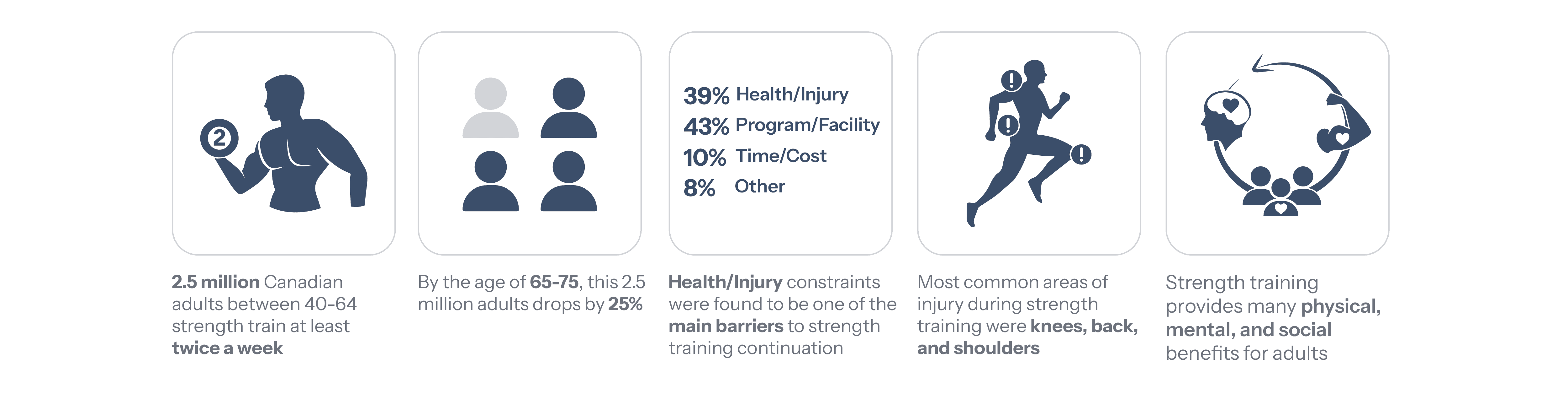
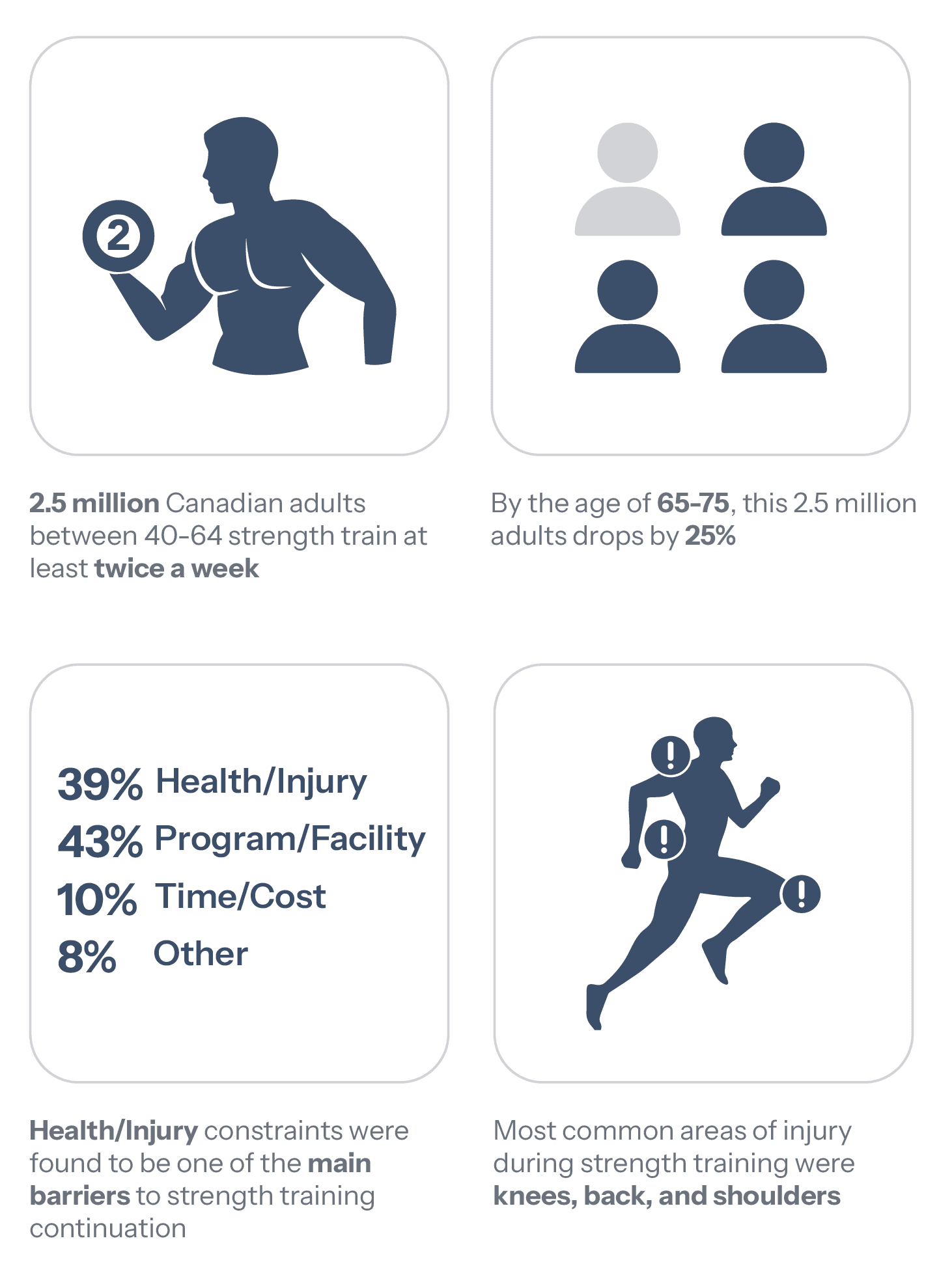
As adults age, strength training becomes essential for preserving mobility, independence, and long-term health. Yet participation declines significantly with age.
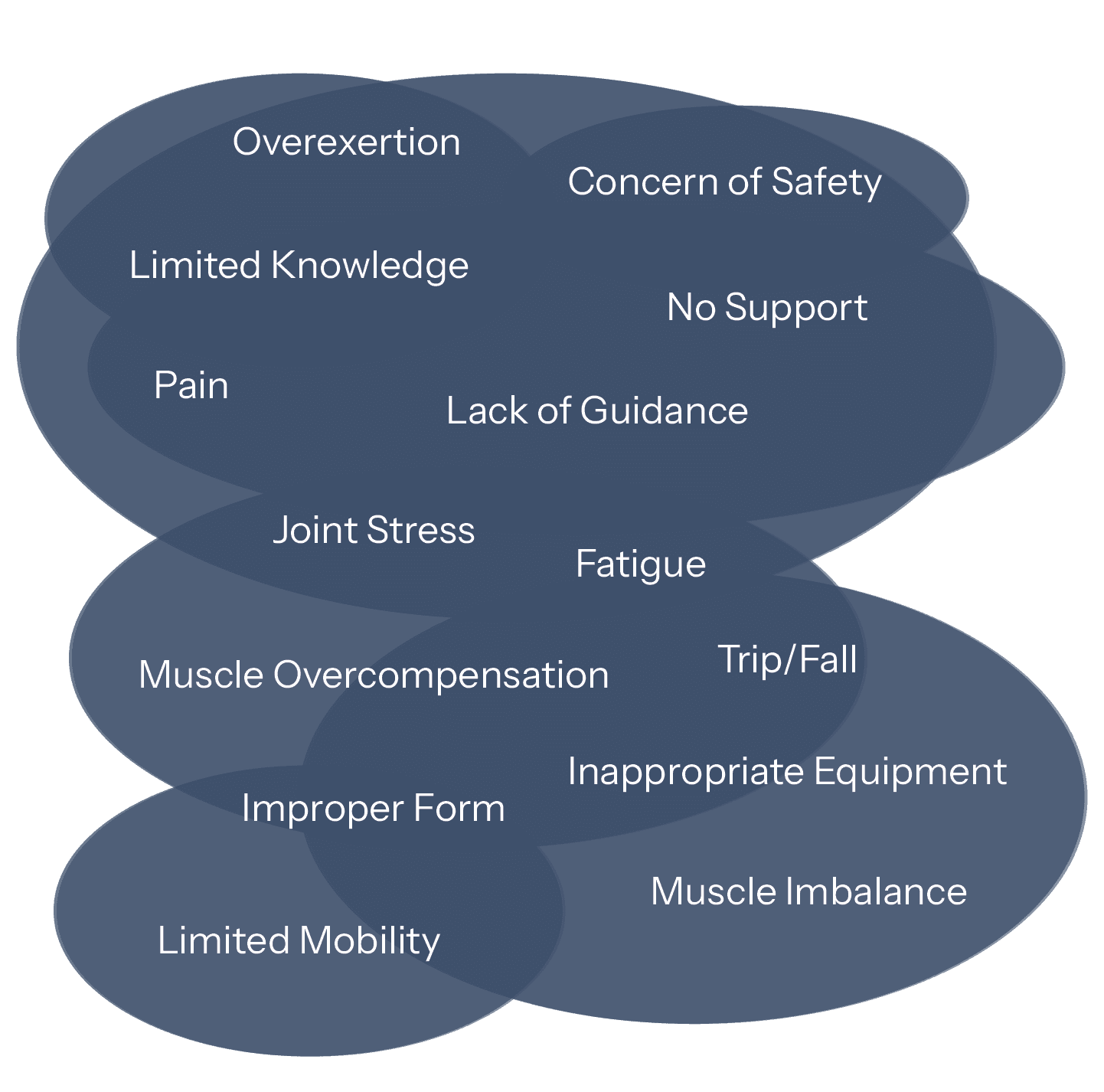
The primary barrier is not motivation, it's fear. Previous injuries, joint pain, uncertainty about proper form, and lack of feedback create hesitation that increases over time. Without guidance on muscle balance and movement control, many older adults disengage from the very activities that support healthy aging.
Strength training is essential for maintaining mobility and independence as we age, yet participation drops significantly after 65.
For many older adults, the issue is not motivation, it's fear. Past injuries, joint pain, uncertainty around proper form, and lack of guidance create hesitation that builds over time.
Without clear feedback or reassurance, confidence declines and training stops.

Opportunity
A safer, more informed path to lifelong strength
As adults age, they need more than motivation to continue training. They need clarity, feedback, and confidence in how their bodies are moving.
There is an opportunity to support older adults with technology that does more than track activity. By integrating muscle activation and joint movement data with real-time guidance, strength training can become more informed, more controlled, and more reassuring.
When feedback is clear and actionable, training shifts from uncertain to intentional, helping adults maintain strength, mobility, and independence with greater confidence.
Older adults need more than motivation to keep training. They need clarity and reassurance that their movements are safe and effective.
By combining muscle and joint data with real-time feedback, strength training can become more informed and less intimidating.
With the right guidance, confidence grows and long-term strength becomes sustainable.
Research & Insights
Uncovering the gaps in strength training wearables
Identifying the gap
To understand why fear of injury limits strength training participation, research focused on aging physiology, muscle decline, injury risk, and the current landscape of wearable technology.
An analysis of user behaviors and existing devices revealed critical gaps in movement accuracy, muscle monitoring, and age-specific feedback. These insights informed the development of a wearable system designed to support safer, more confident training.
Research explored aging physiology, injury risk, and the current wearable landscape to understand why older adults disengage from strength training.
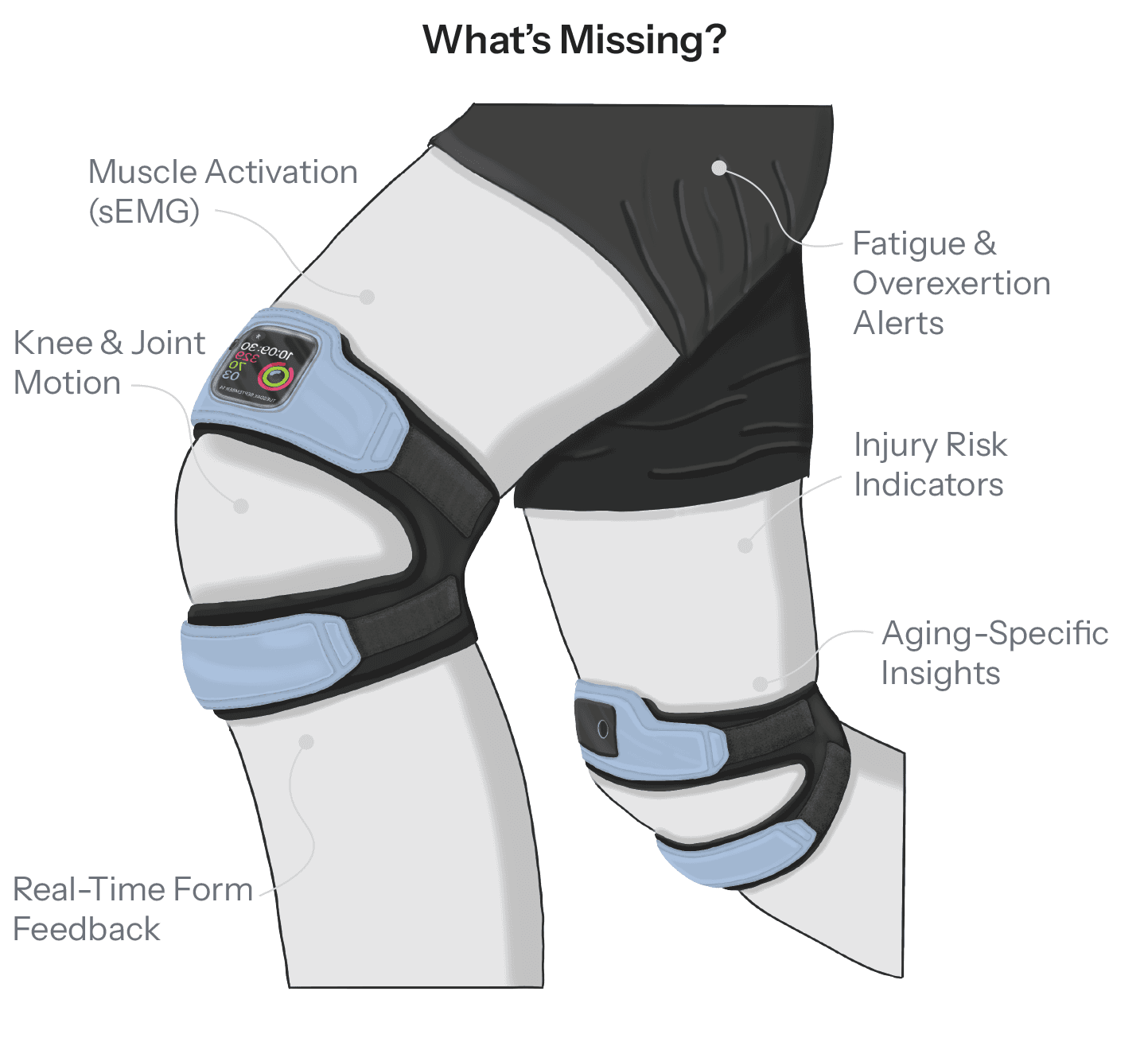
While wearable technology continues to grow, most devices focus on steps, heart rate, and general activity tracking. They lack the ability to measure muscle activation, joint mechanics, and fatigue in real time.
This gap limits their usefulness for safe, informed strength training.
Current State of Wearables
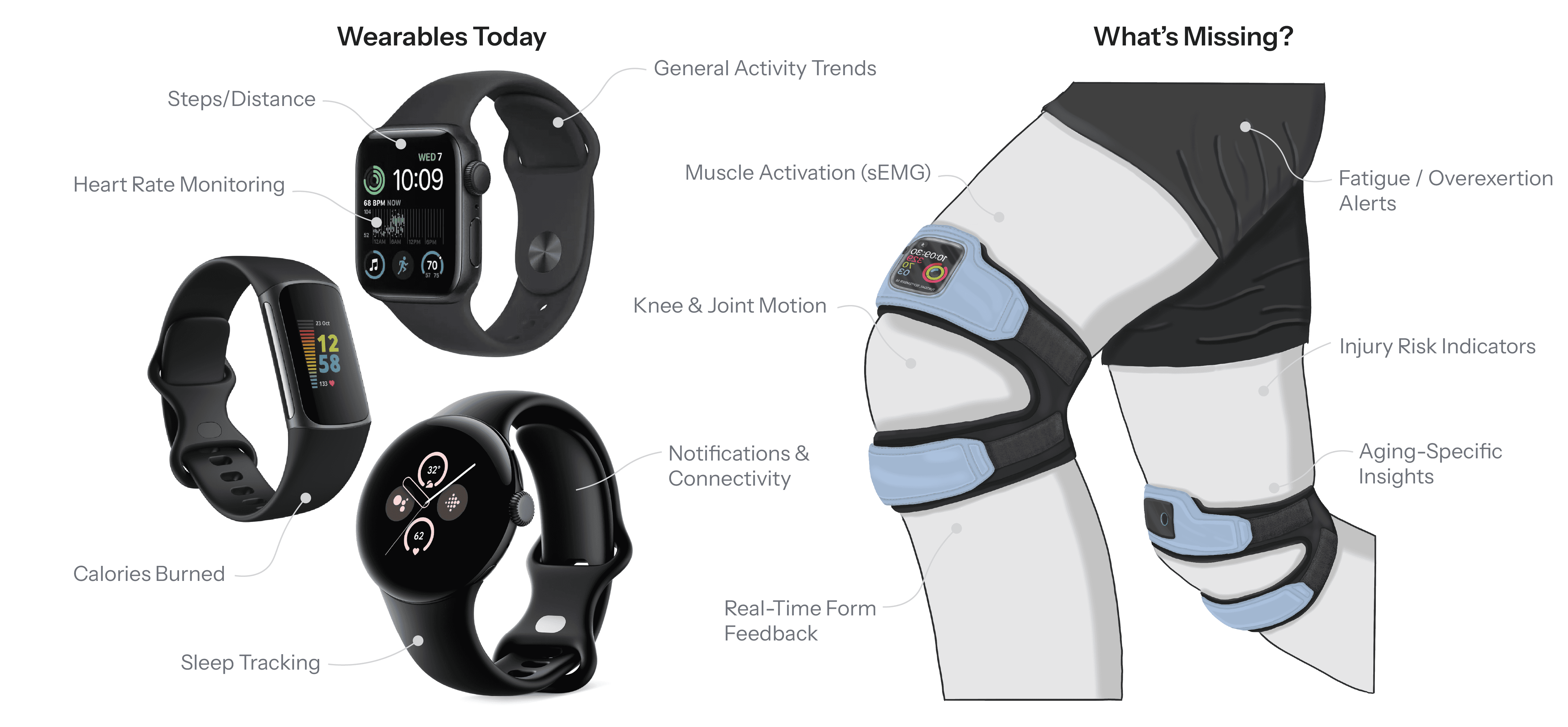
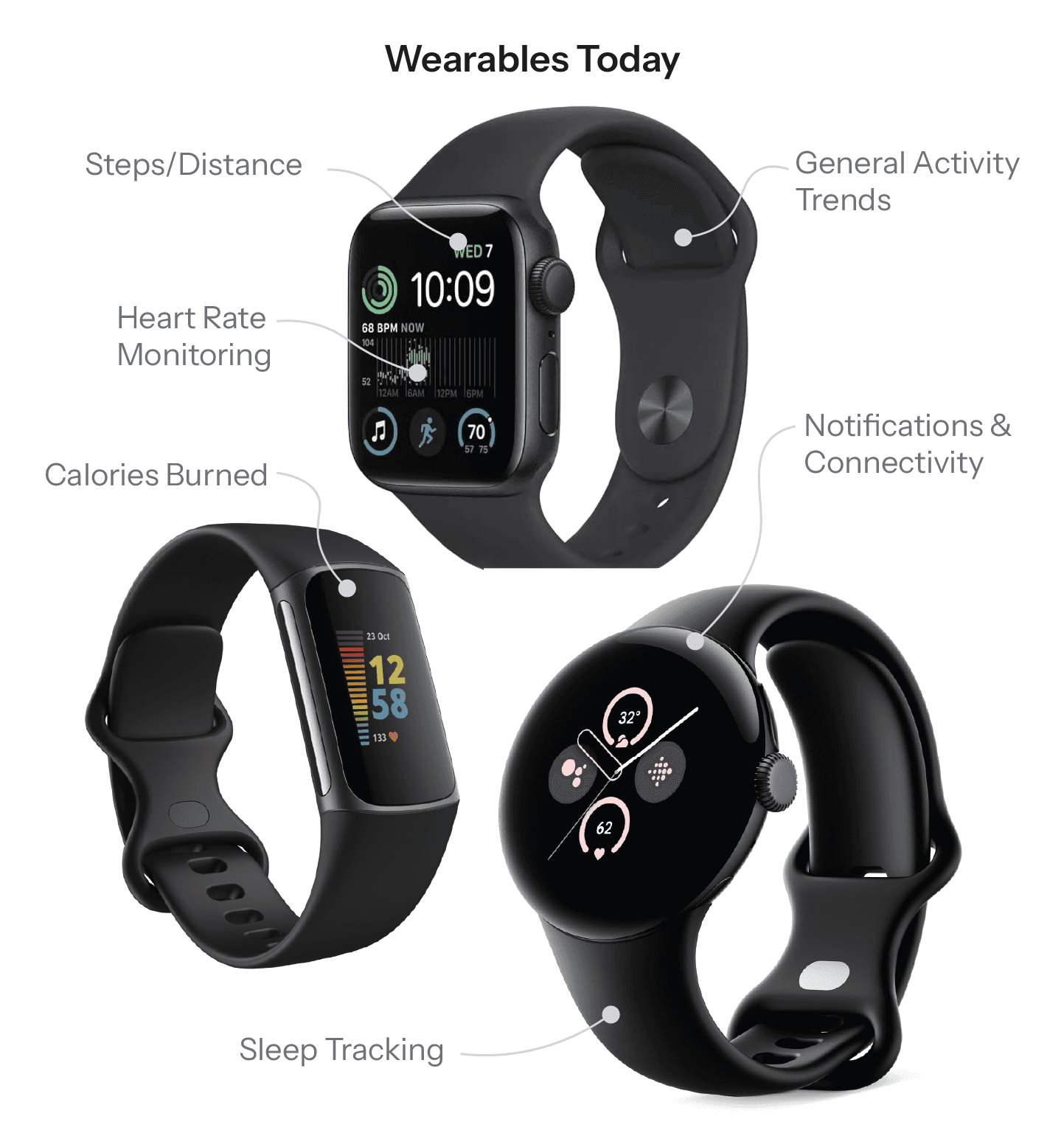
Wearable technology continues to expand rapidly, with significant projected market growth through 2030. However, most consumer devices remain wrist-worn trackers focused on steps, heart rate, and general activity trends.
While effective for high-level health metrics, these devices lack the precision required for strength training. They do not monitor muscle activation, joint alignment, or fatigue in real time, limiting their ability to reduce injury risk or provide meaningful form feedback.
Wearable technology continues to expand rapidly, with significant projected market growth through 2030. However, most consumer devices remain wrist-worn trackers focused on steps, heart rate, and general activity trends.
While effective for high-level health metrics, these devices lack the precision required for strength training. They do not monitor muscle activation, joint alignment, or fatigue in real time, limiting their ability to reduce injury risk or provide meaningful form feedback.
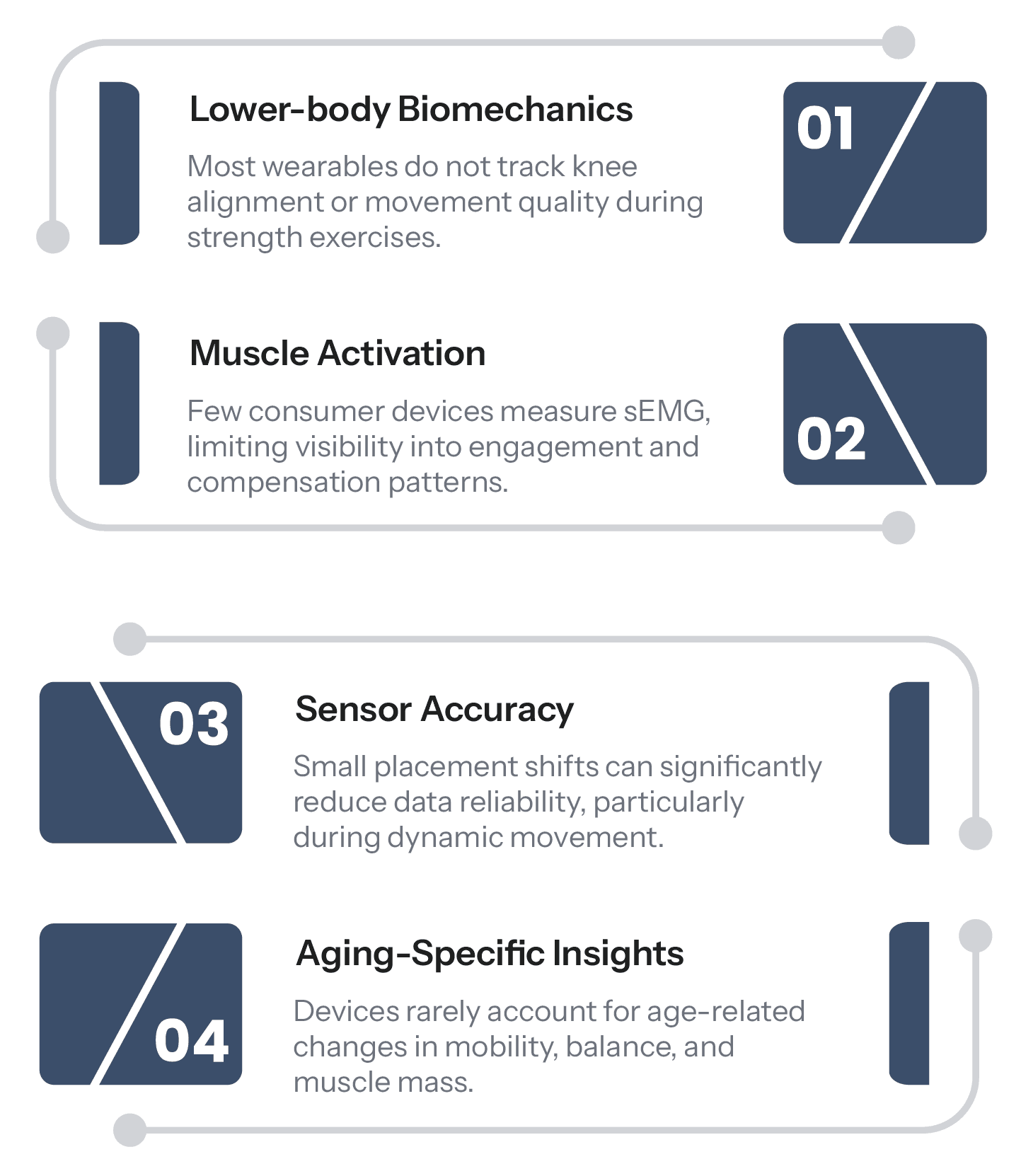
Missing Capabilities for Strength Training & Aging
Why this matters
Without real-time feedback on form, fatigue, and muscle engagement, strength training becomes uncertain, particularly for older adults. Poor technique and hidden imbalances increase injury risk and discourage long-term consistency.
A wearable that measures muscle activation, tracks joint mechanics, and delivers actionable feedback can reduce uncertainty and support safer, more sustainable training.
Without real-time feedback on muscle engagement and joint mechanics, strength training becomes uncertain. Hidden imbalances and fatigue increase injury risk and reduce long-term consistency.
Clear, actionable feedback is necessary to make training both safe and sustainable.
User Insights
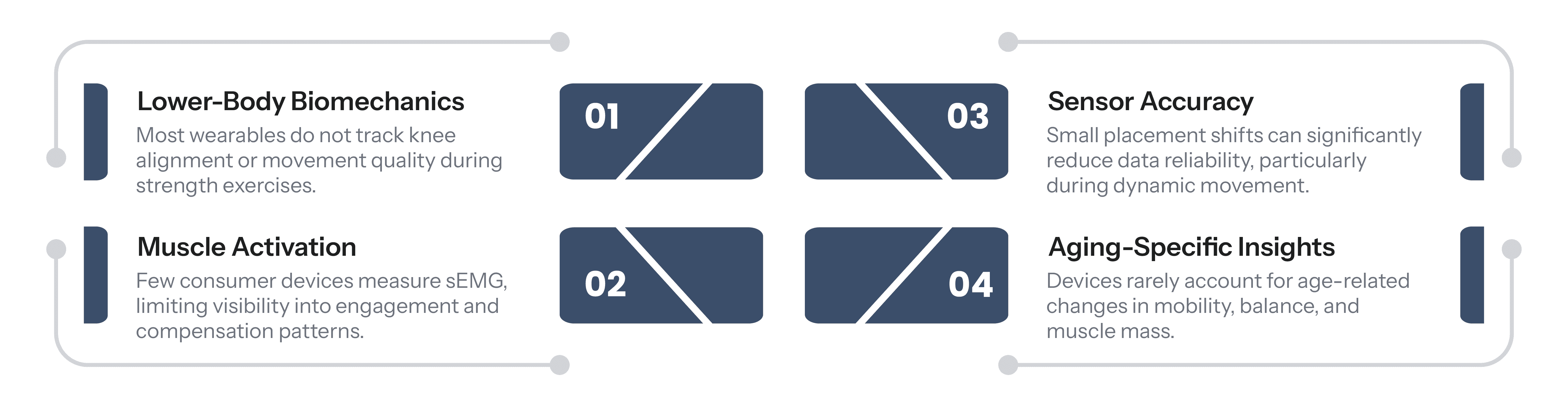
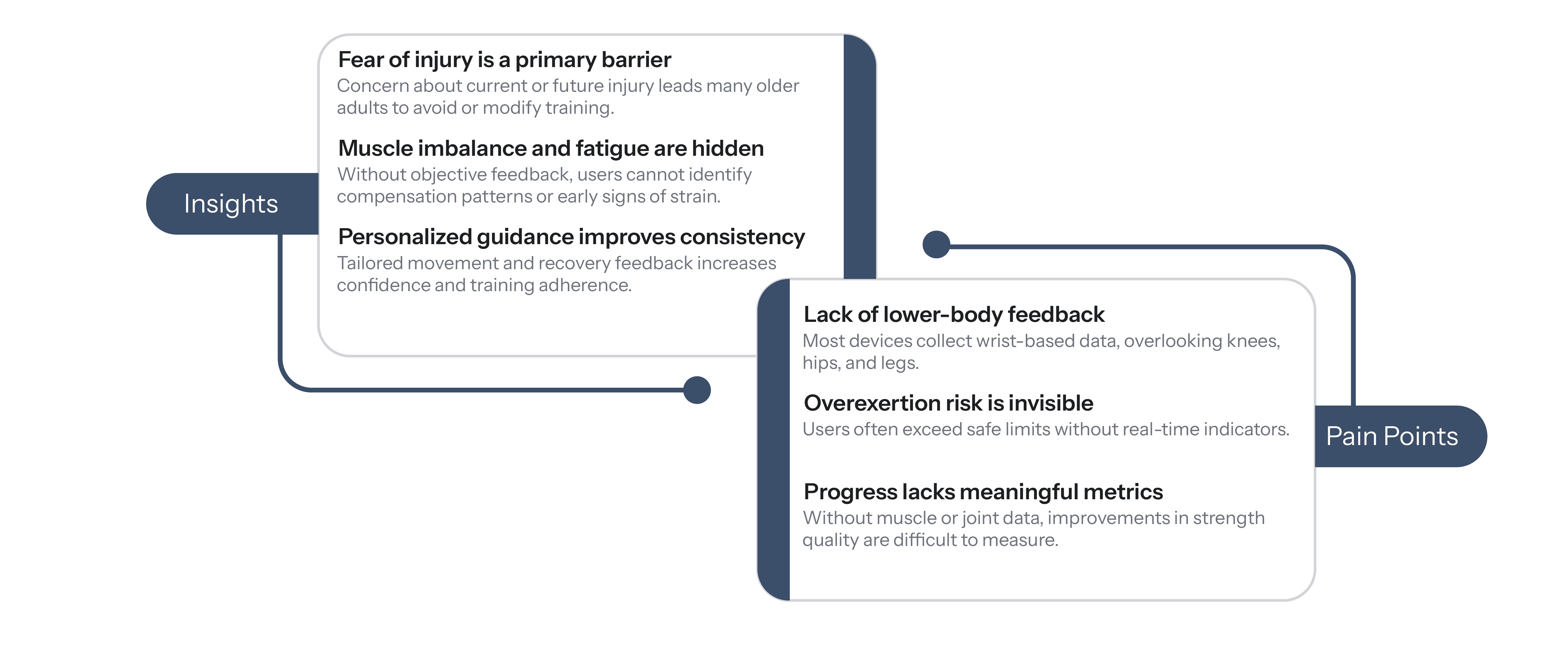
User interviews and secondary research revealed consistent patterns in how older adults and returning athletes approach strength training. These insights clarified both emotional and functional barriers that current wearables fail to address.
Research and interviews revealed consistent barriers among older adults and returning athletes:

Key Takeaway
These findings established a clear requirement: a wearable system that delivers lower-body biomechanics data, muscle activation feedback, and age-informed guidance to support safe, confident, and consistent strength training.
There is a clear need for a wearable system that delivers lower-body biomechanics data, muscle activation feedback, and age-informed guidance to support safe, confident strength training.
Concept Development
Building support into every detail
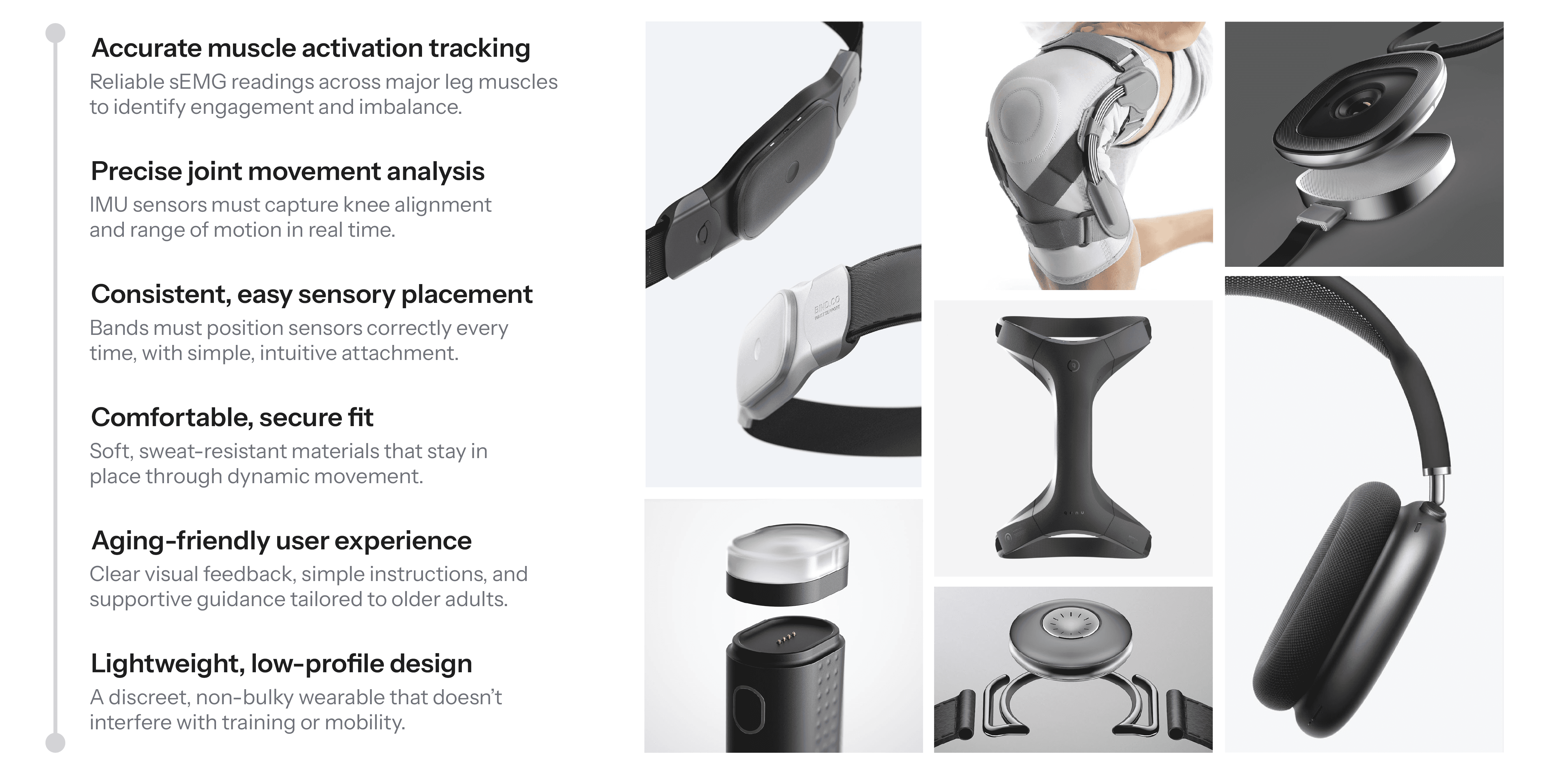
Research revealed a clear need for lower-body biomechanics tracking, muscle activation visibility, and age-informed guidance. These requirements shaped the direction of the concept exploration.
The focus shifted from general activity tracking to precise lower-body sensing, intuitive feedback, and a wearable form that feels stable, supportive, and easy to use during strength training. Every design decision prioritized clarity, comfort, and confidence in movement.
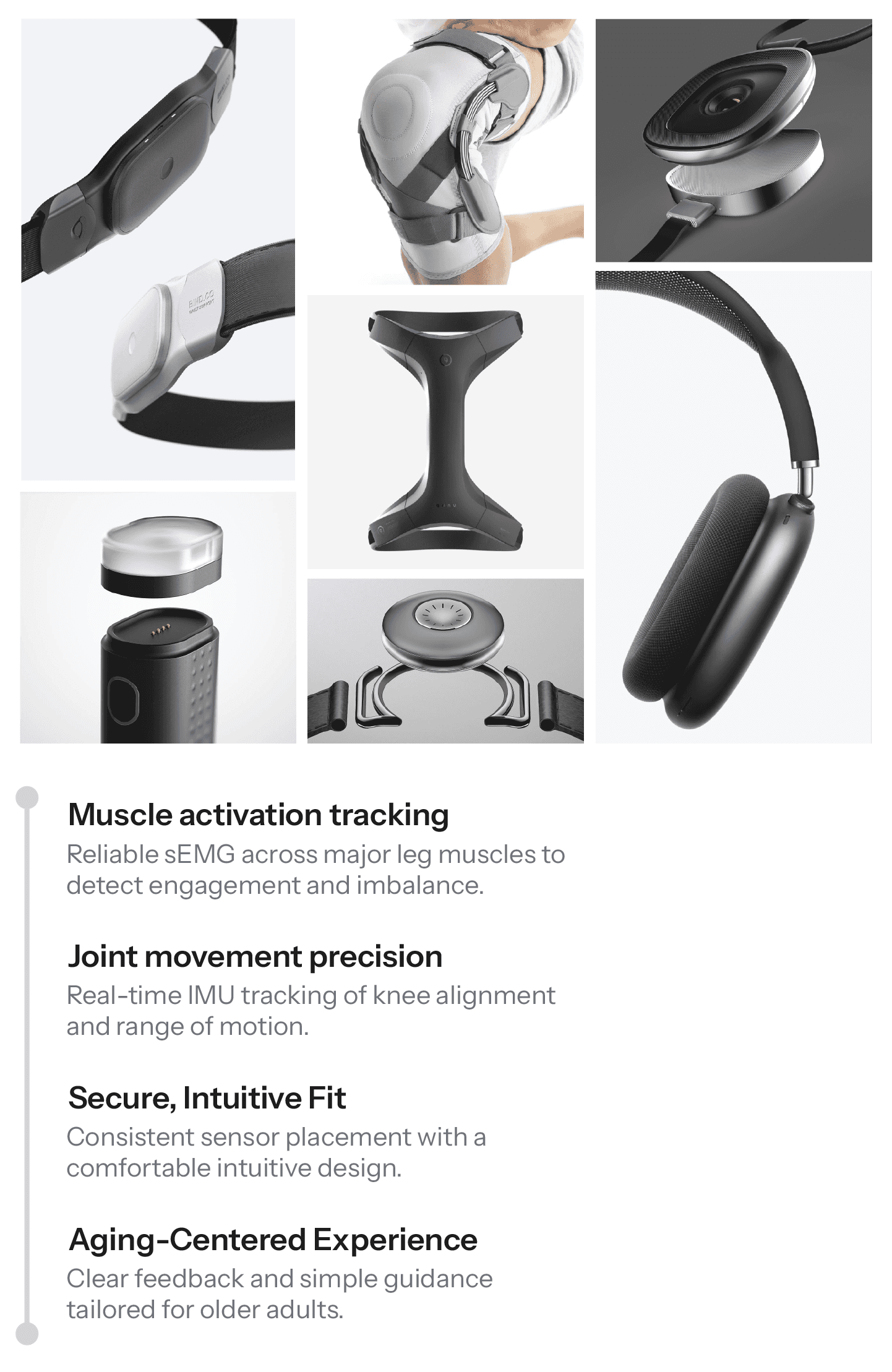
Research defined clear requirements: accurate lower-body sensing, visible muscle activation, and age-informed guidance. These insights shaped the design direction.
The concept focused on precise joint tracking, reliable sEMG placement, intuitive attachment, and a secure, comfortable form that supports confident movement.
Exploration
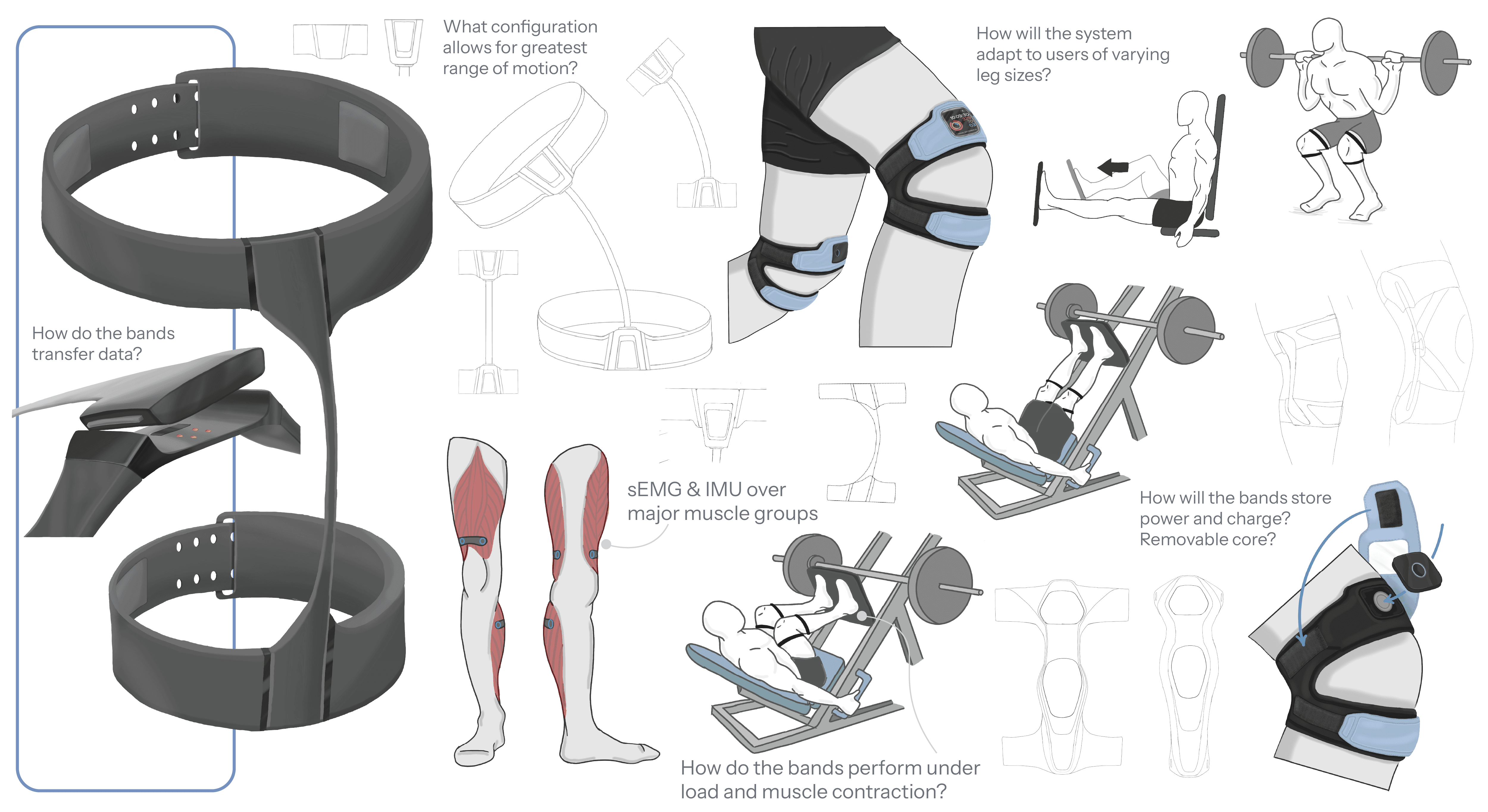
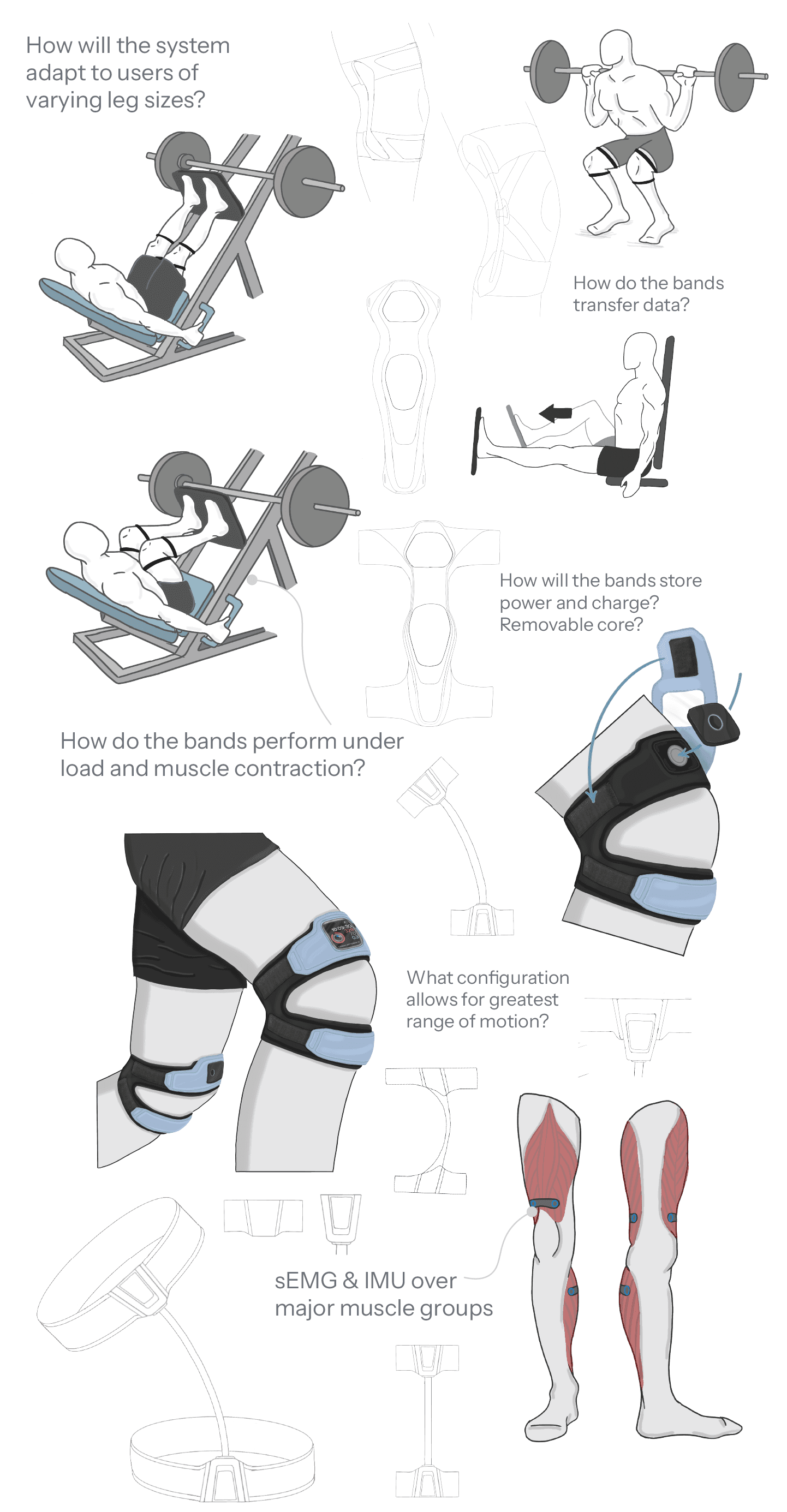
Early ideation explored multiple band configurations, sensor placements, and system architectures to determine how lower-body data could be captured accurately without compromising comfort.
Movement scenarios such as squats, lunges, step-ups, and leg press exercises were used to test how the bands would flex, rotate, and maintain alignment under load. Hinge systems, magnetic connectors, embedded wiring, and material compositions were evaluated to balance durability with wearability.
These explorations established the structural and ergonomic foundation of the final system.
Multiple band forms and sensor placements were tested to determine how the device could maintain alignment during squats, lunges, and leg presses. Material studies and hinge mechanisms were explored to balance flexibility with stability.
System Mapping
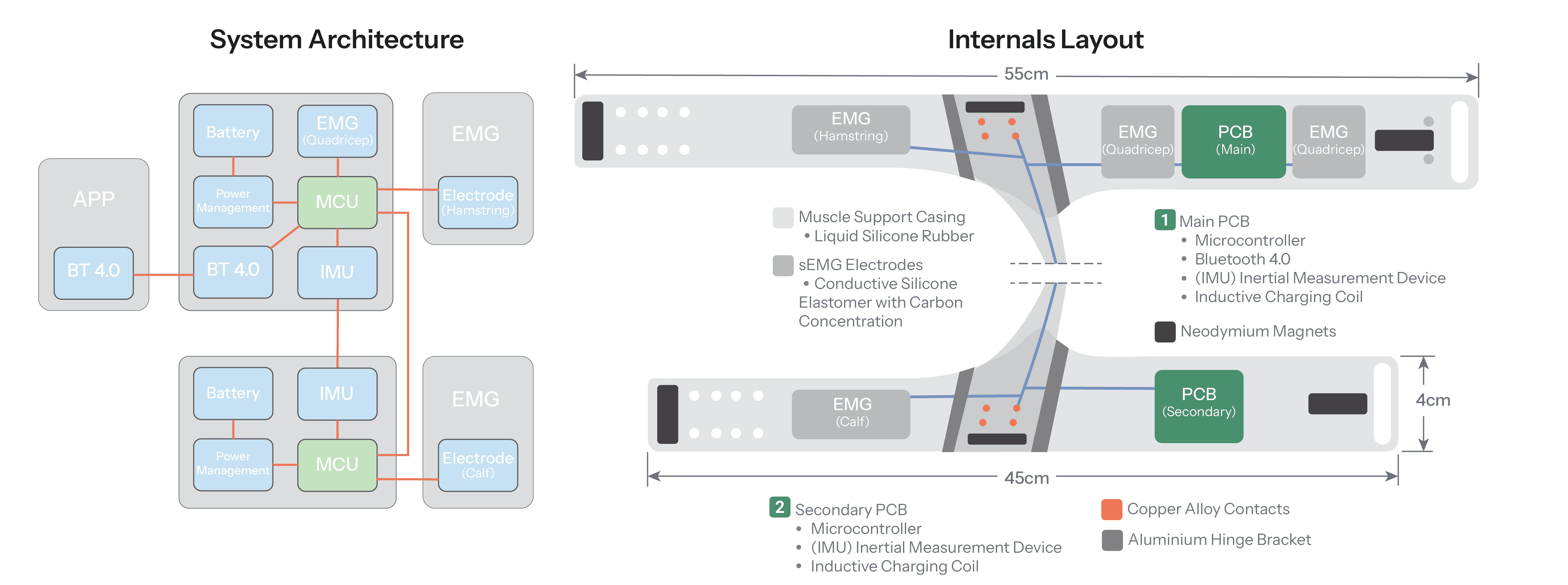
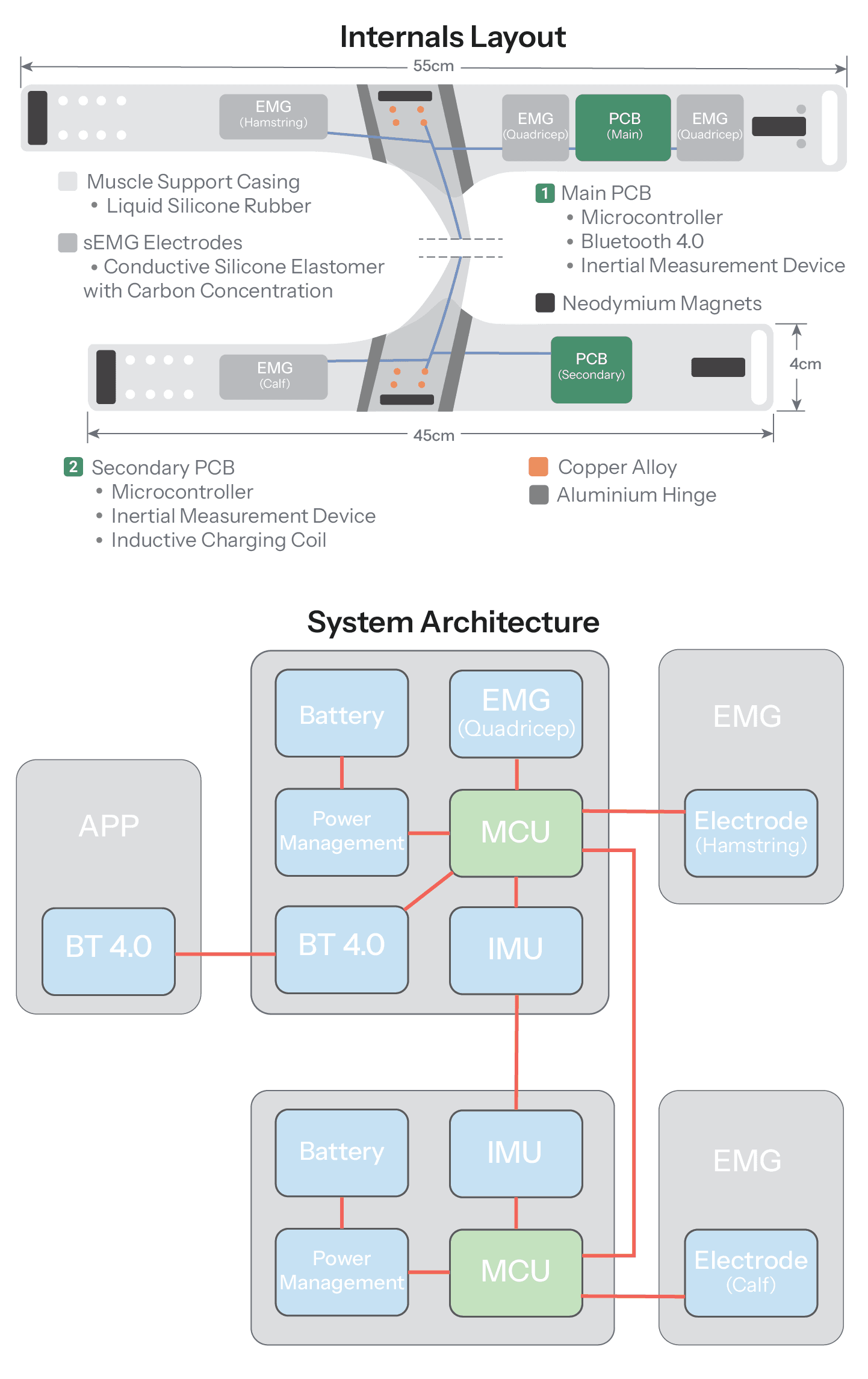
To ensure seamless integration between hardware and software, the placement of each sEMG and IMU sensor was mapped alongside the main and secondary PCBs. This clarified how muscle signals and motion data flow through the system before reaching the mobile application.
Mapping the internal architecture helped balance component distribution, maintain signal reliability, and preserve a comfortable, wearable form.
Sensor placement and PCB architecture were mapped to understand how muscle and motion data flow through the system. This ensured reliable signal transmission while maintaining a balanced wearable form.
Prototyping
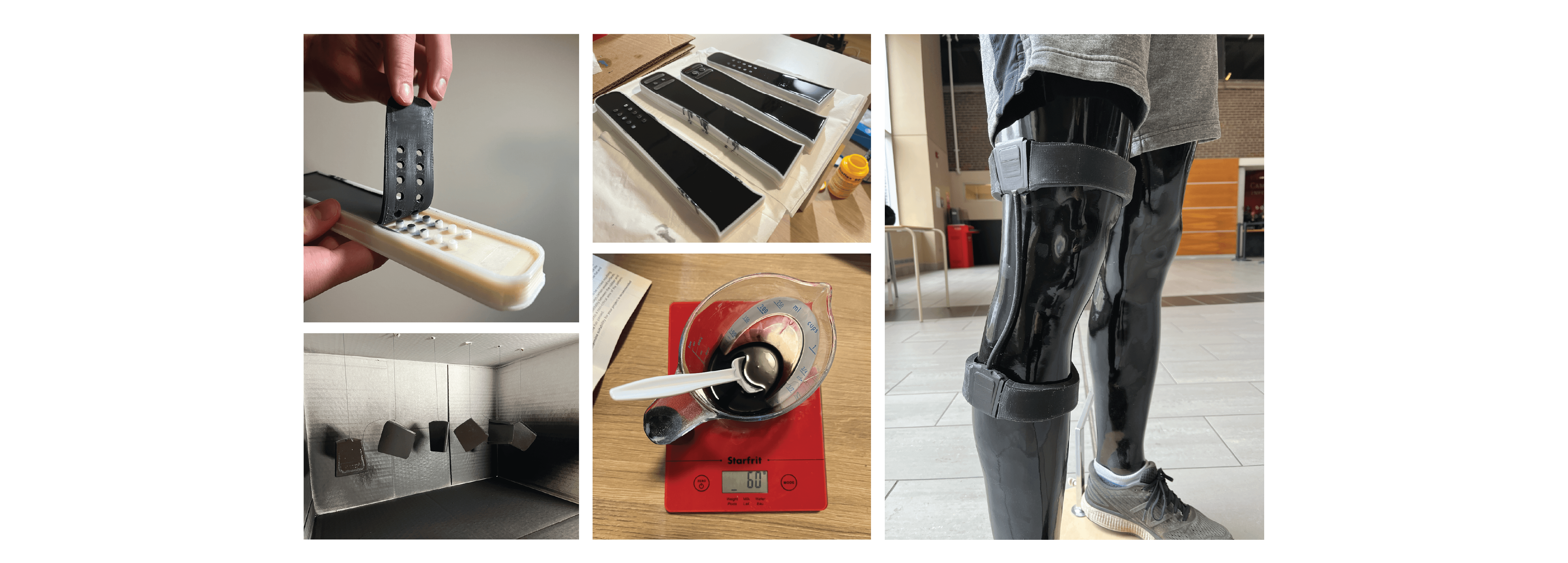
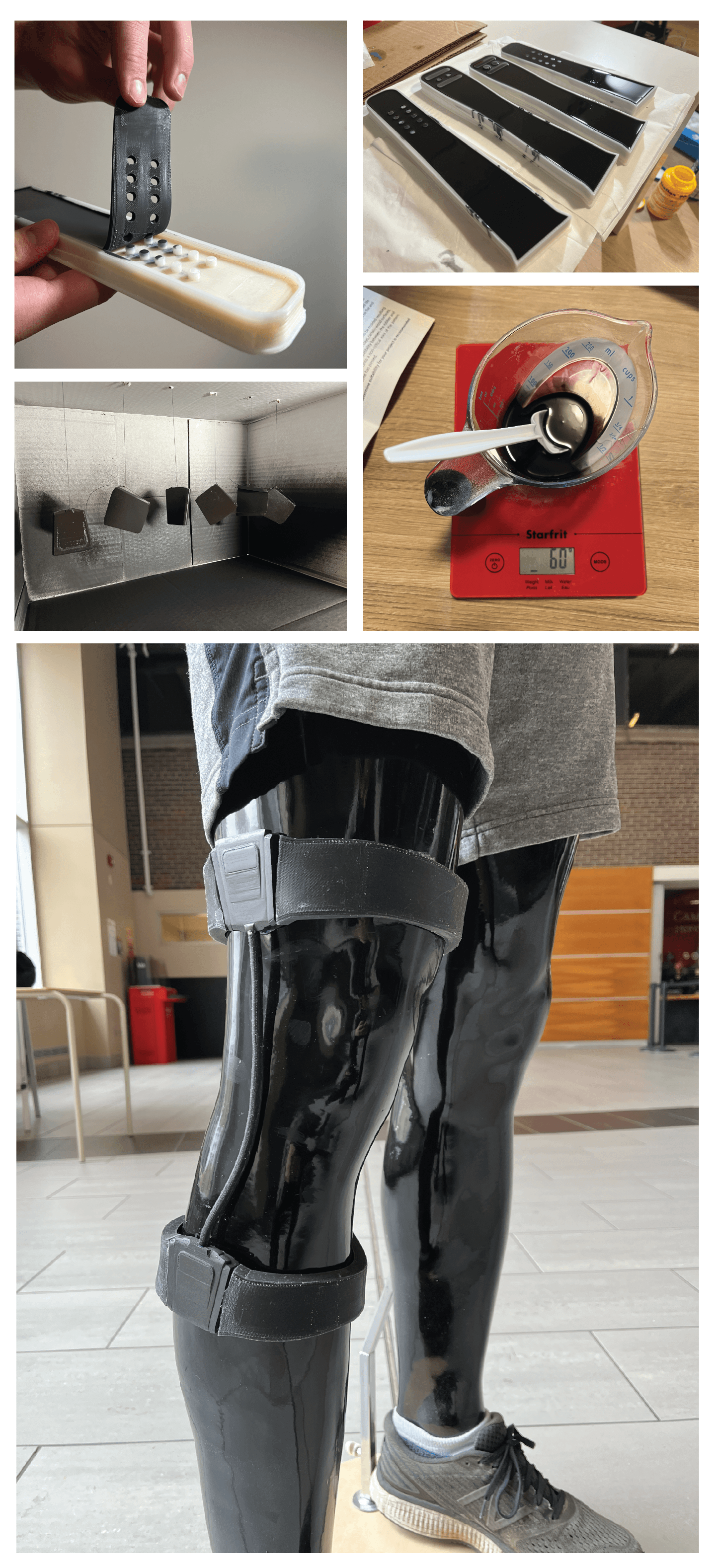
A “looks-like” prototype was developed to validate fit, ergonomics, and overall form. ABS dies were 3D printed to cast liquid silicone bands, and hinge components were printed to replicate flexibility and movement.
This physical model enabled evaluation of comfort, alignment, and stability across real strength-training positions before finalizing the design.
A physical “looks-like” prototype validated ergonomics, flexibility, and fit across real training positions before finalizing the design.
Final Design
4 bands synced to learn how you move, and move with you
4 bands synced to learn how you move
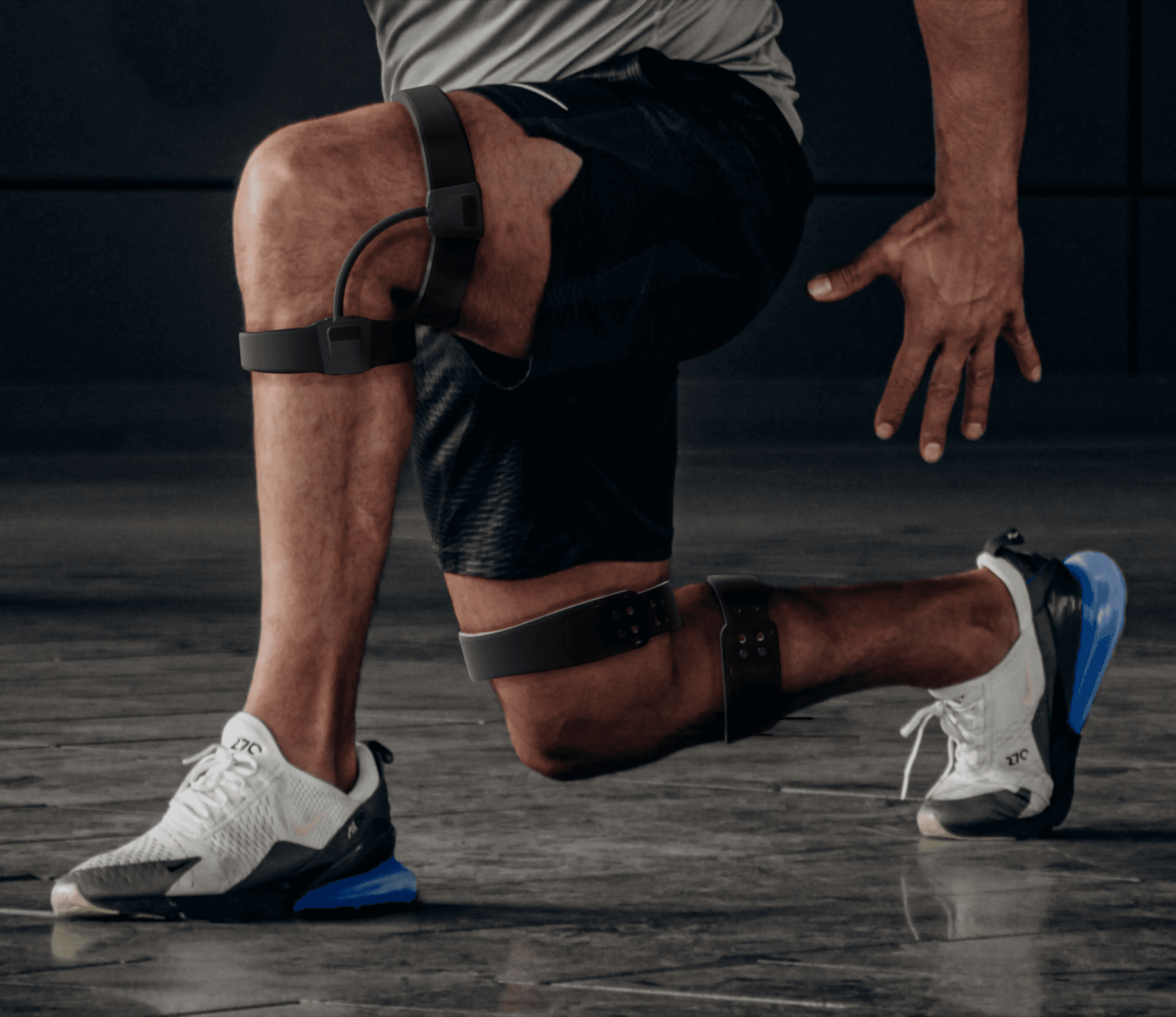
4Support uses four coordinated bands embedded with sEMG and IMU sensors to monitor muscle activation and knee movement in real time. Together, they track how your muscles engage, how your joint moves, and how both shift under fatigue. By capturing this data before, during, and after a workout, the system provides continuous insight designed to reduce lower-body strain and support safer training.
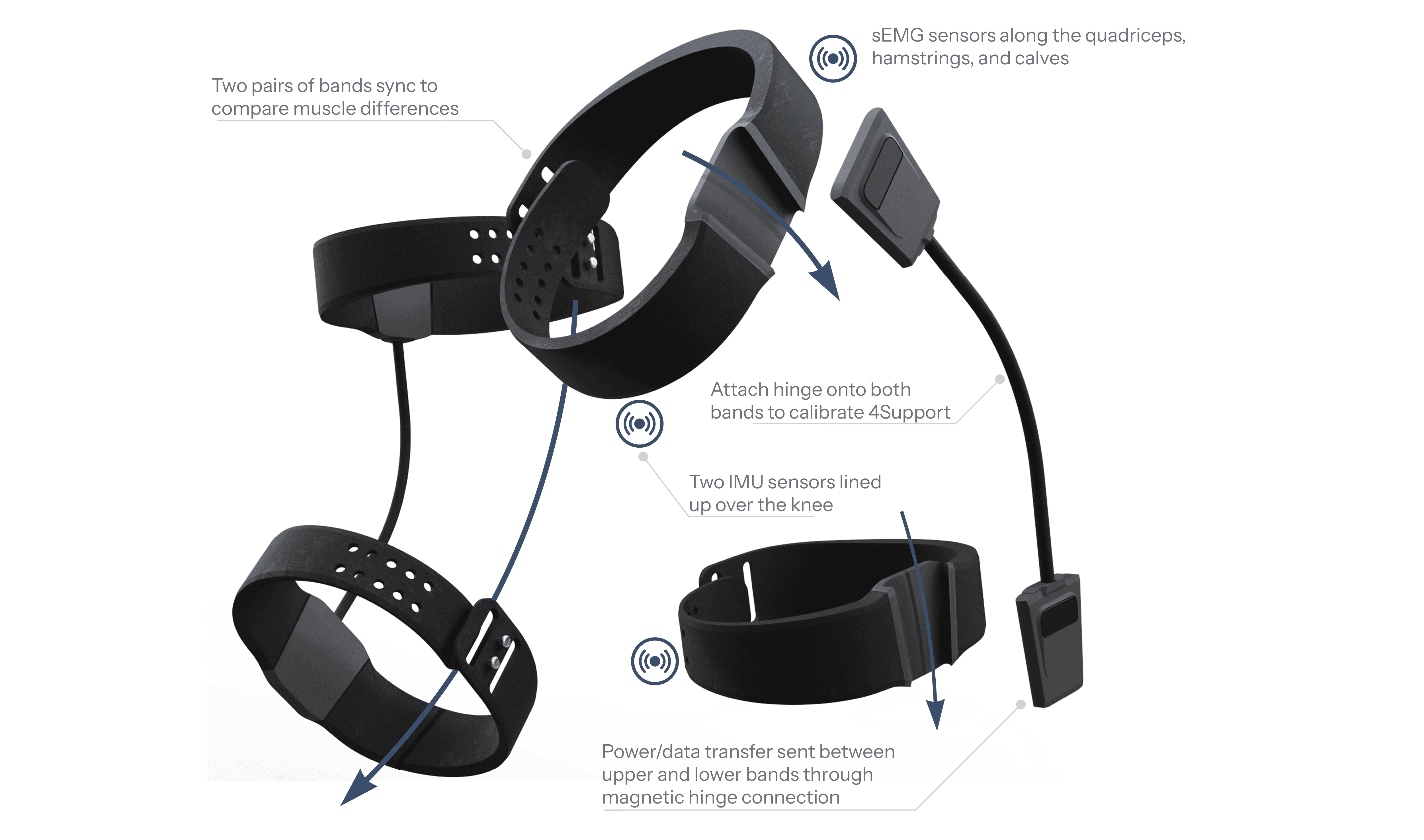
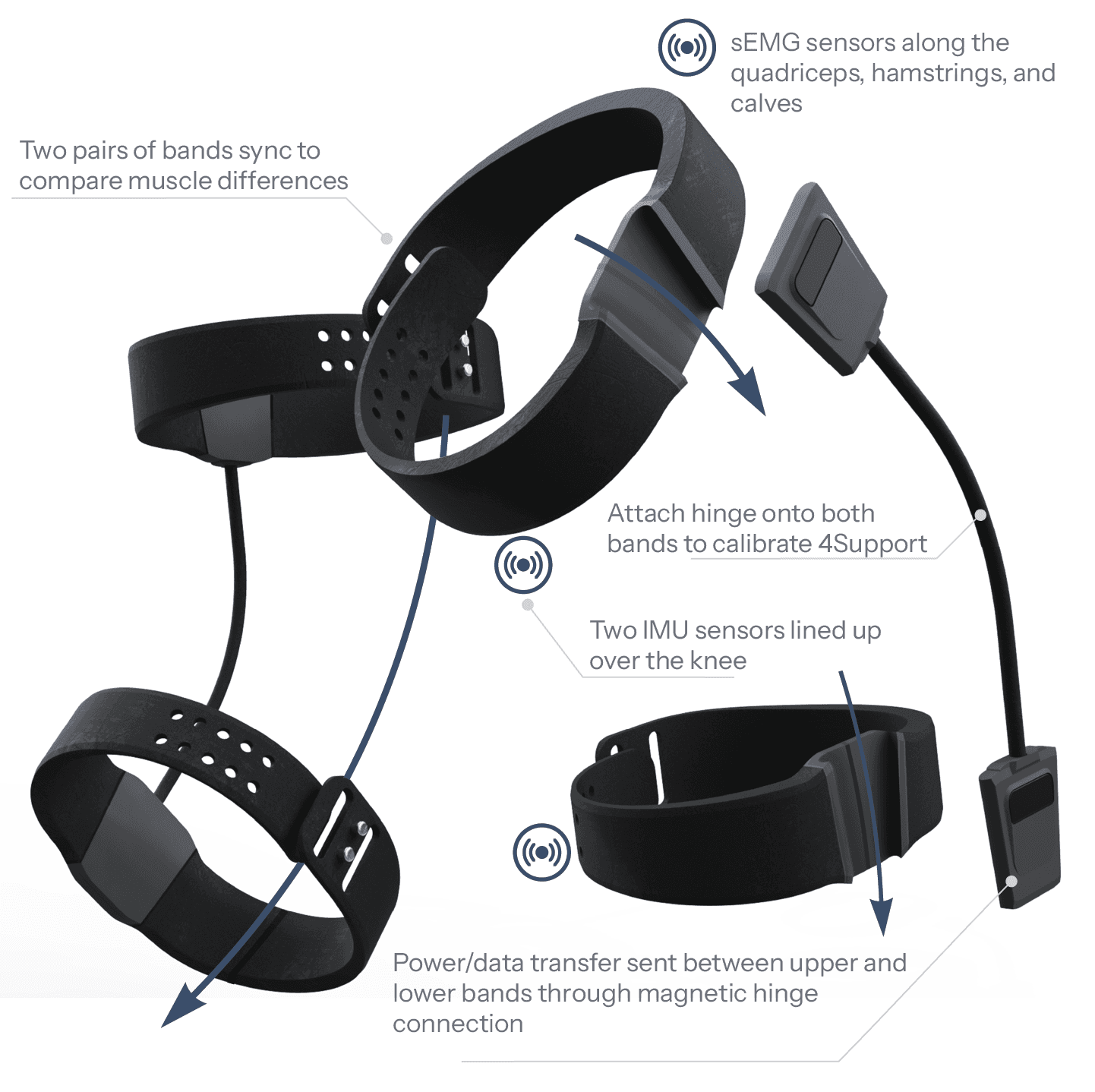
Two pairs of bands sync to compare muscle differences across the quadriceps, hamstrings, and calves. This dual-band architecture allows 4Support to detect imbalances and asymmetries that often go unnoticed but contribute to injury over time.
4Support uses four synced bands with embedded sEMG and IMU sensors to track muscle activation and knee movement in real time.
By comparing upper and lower muscle engagement across both legs, the system detects imbalances, monitors fatigue, and supports safer training before, during, and after every workout.
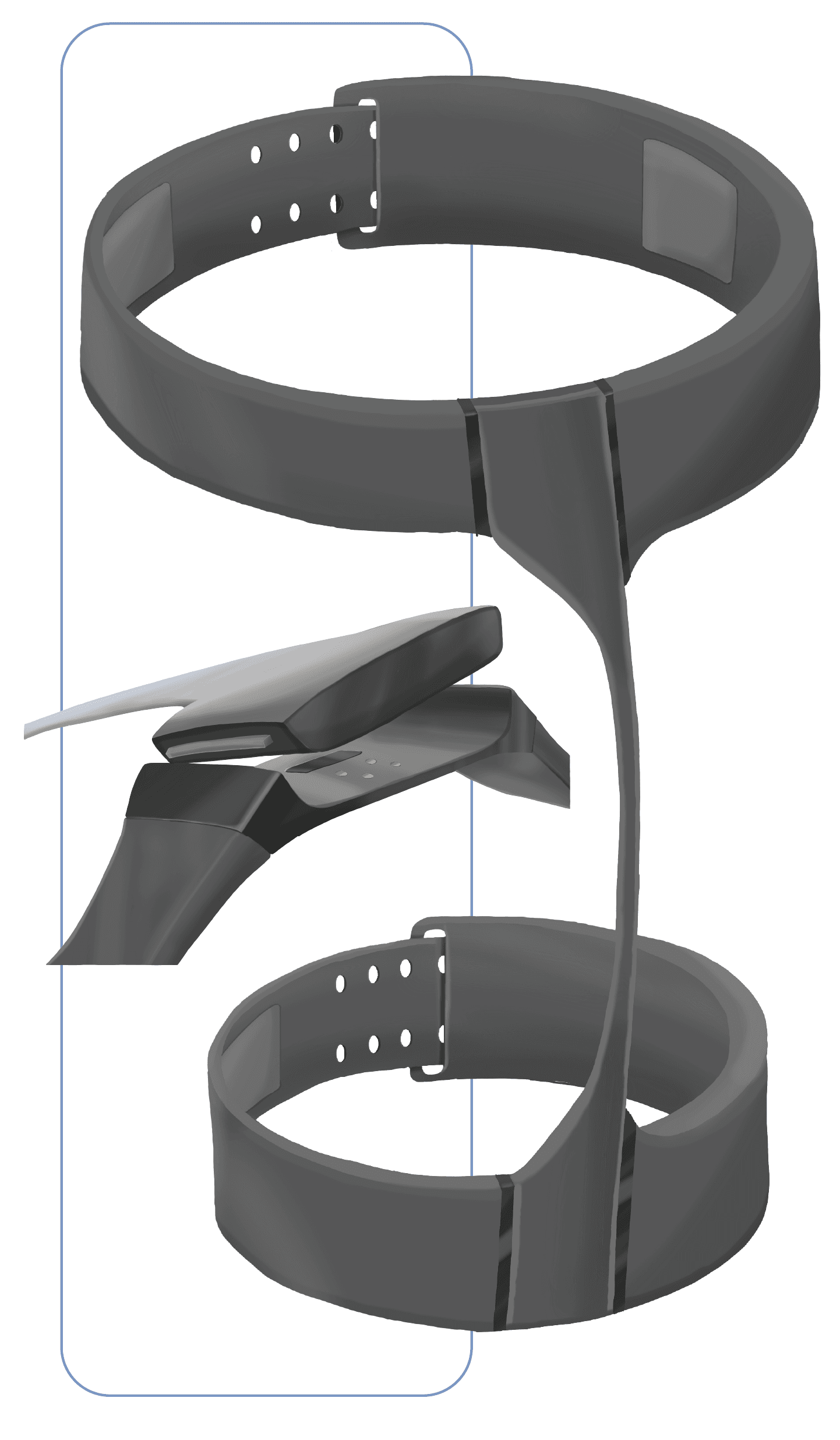
Hinge Locking + Power/Data Transfer
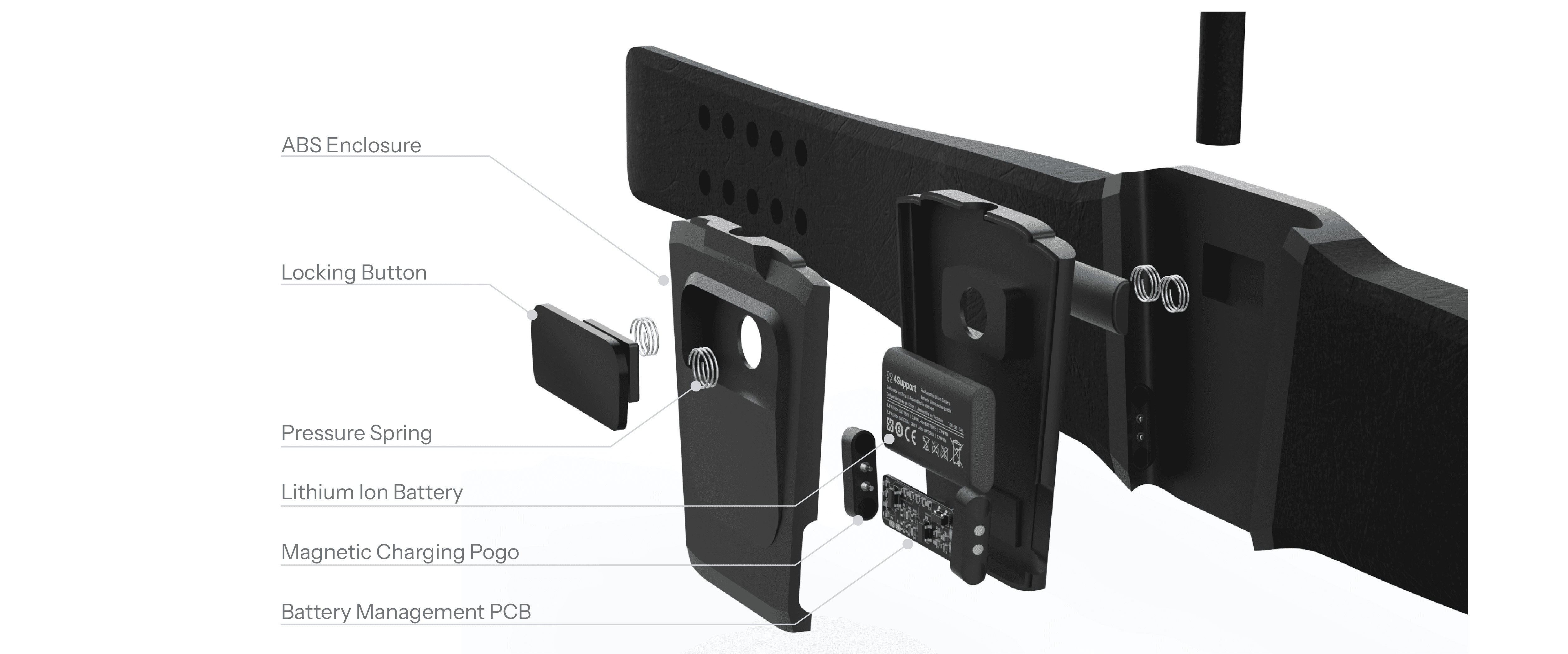
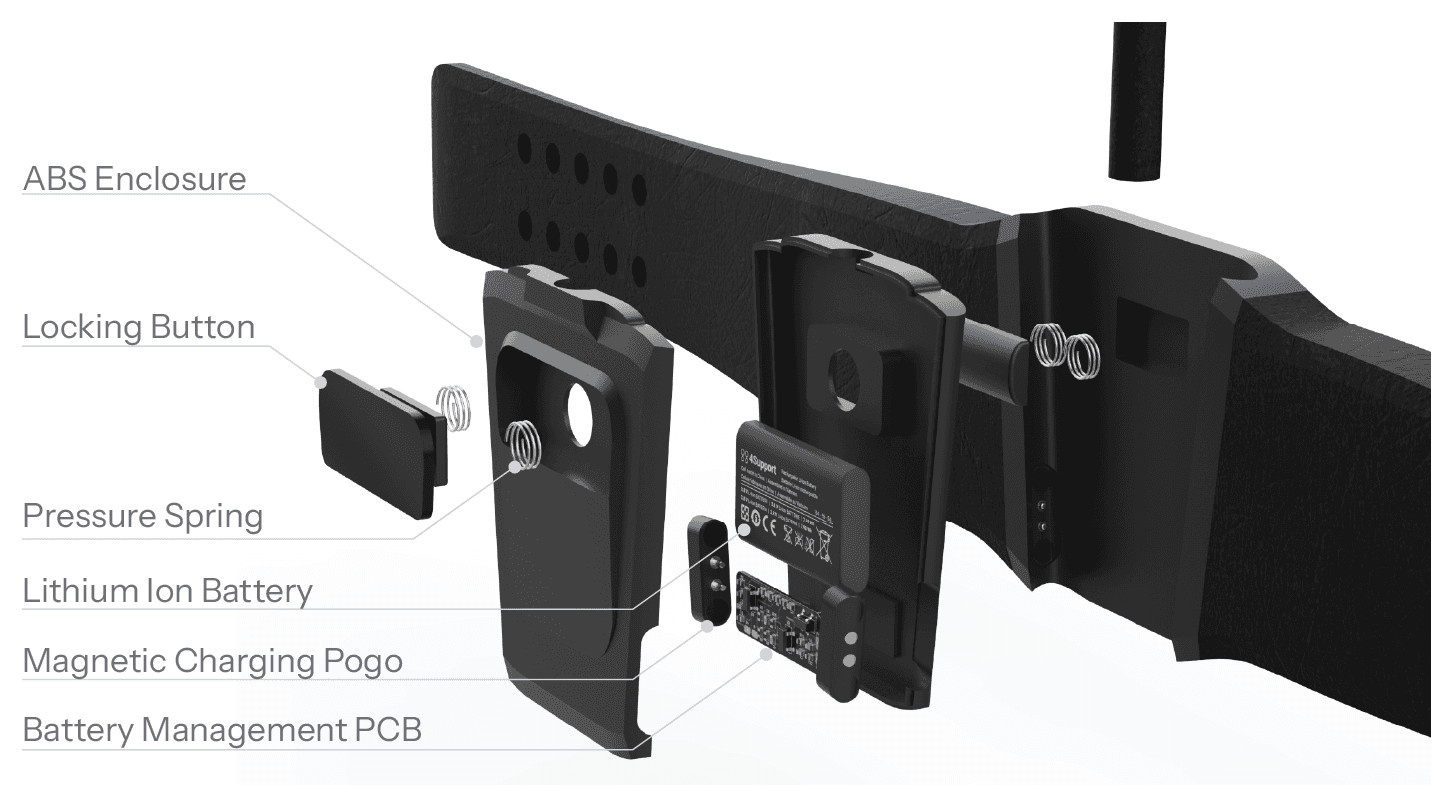
A magnetic hinge connects the upper and lower bands, allowing the knee to move naturally while securely linking the system. Once attached, the hinge calibrates alignment and creates a seamless channel for both power and sensor data transfer.
This integrated connection ensures stable communication between components, enabling uninterrupted real-time monitoring and responsive feedback throughout every movement.
A magnetic hinge connects the upper and lower bands, allowing the knee to move naturally while keeping the system securely aligned.
Once attached, it calibrates automatically and transfers both power and sensor data between bands, enabling seamless real-time monitoring.
Muscle Monitoring Bands
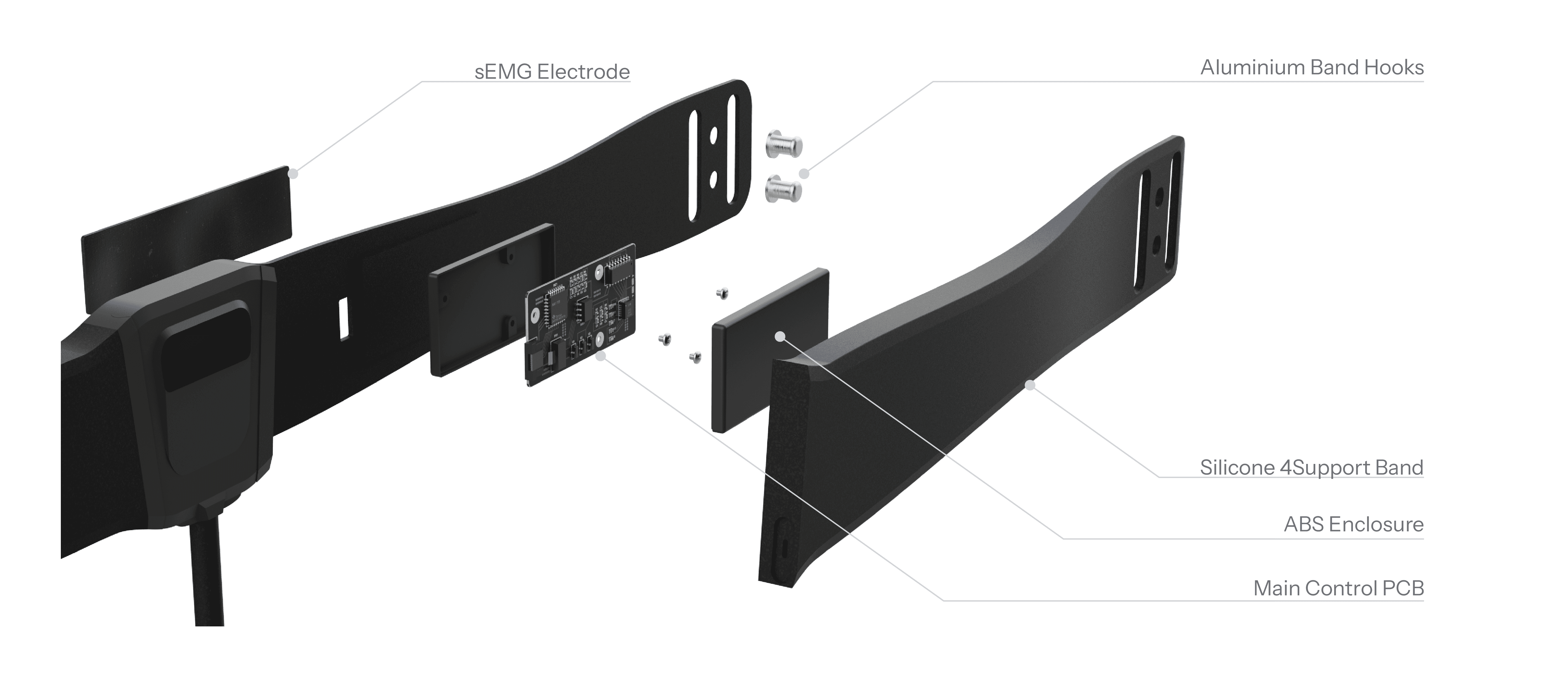
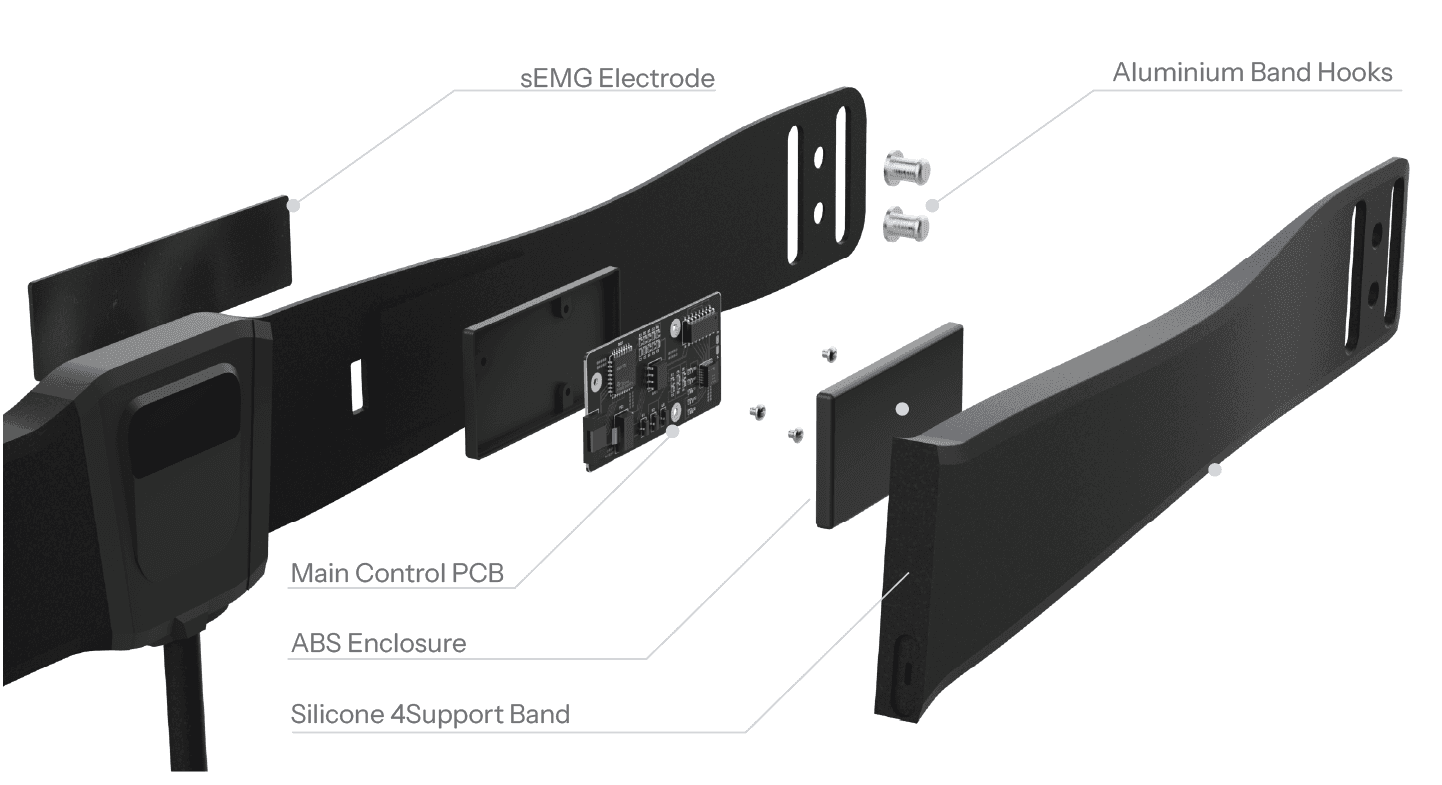
Each band is designed to capture precise muscle activation through embedded sEMG electrodes while housing the necessary PCBs for on-device signal processing. The form wraps securely yet comfortably around the leg, positioning sensors consistently across the target muscle groups.
By aligning hardware placement with anatomical landmarks, the system improves signal accuracy and helps users better understand engagement patterns, fatigue progression, and muscular imbalances.
Each band captures precise muscle activity through embedded sEMG electrodes while housing onboard processing components.
The ergonomic placement ensures consistent sensor contact across key muscle groups, helping users track engagement patterns and identify imbalances.
PCB + Sensor Data Flow
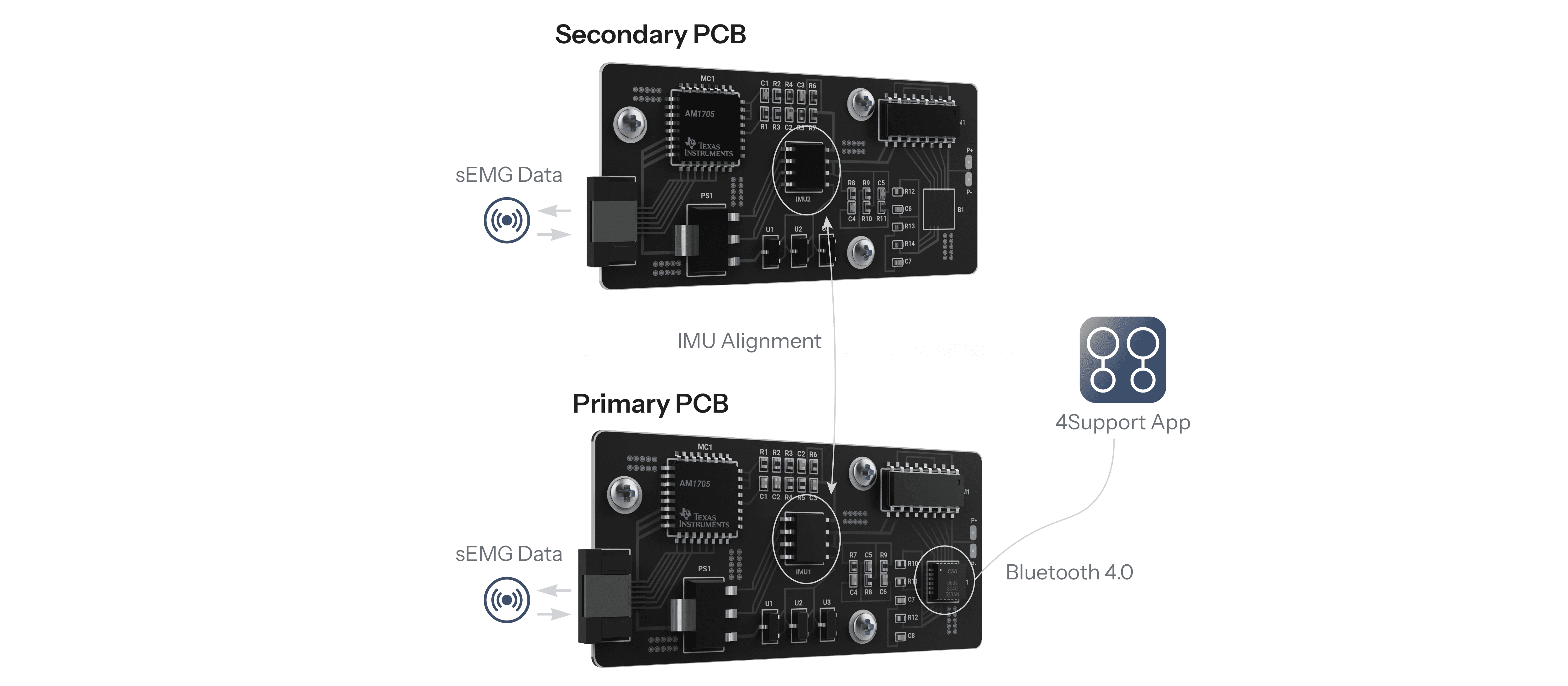
The Primary and Secondary PCBs work together to process raw sEMG and IMU signals directly on the device. After filtering and structuring the data, the system transmits it via Bluetooth to the 4Support app.
This architecture transforms complex sensor input into meaningful performance metrics, enabling real-time form correction and movement guidance without interrupting the workout experience.
Primary and Secondary PCBs process raw sEMG and IMU signals directly on the device.
The refined data is then transmitted via Bluetooth to the 4Support app, turning complex inputs into clear performance insights.
App Design
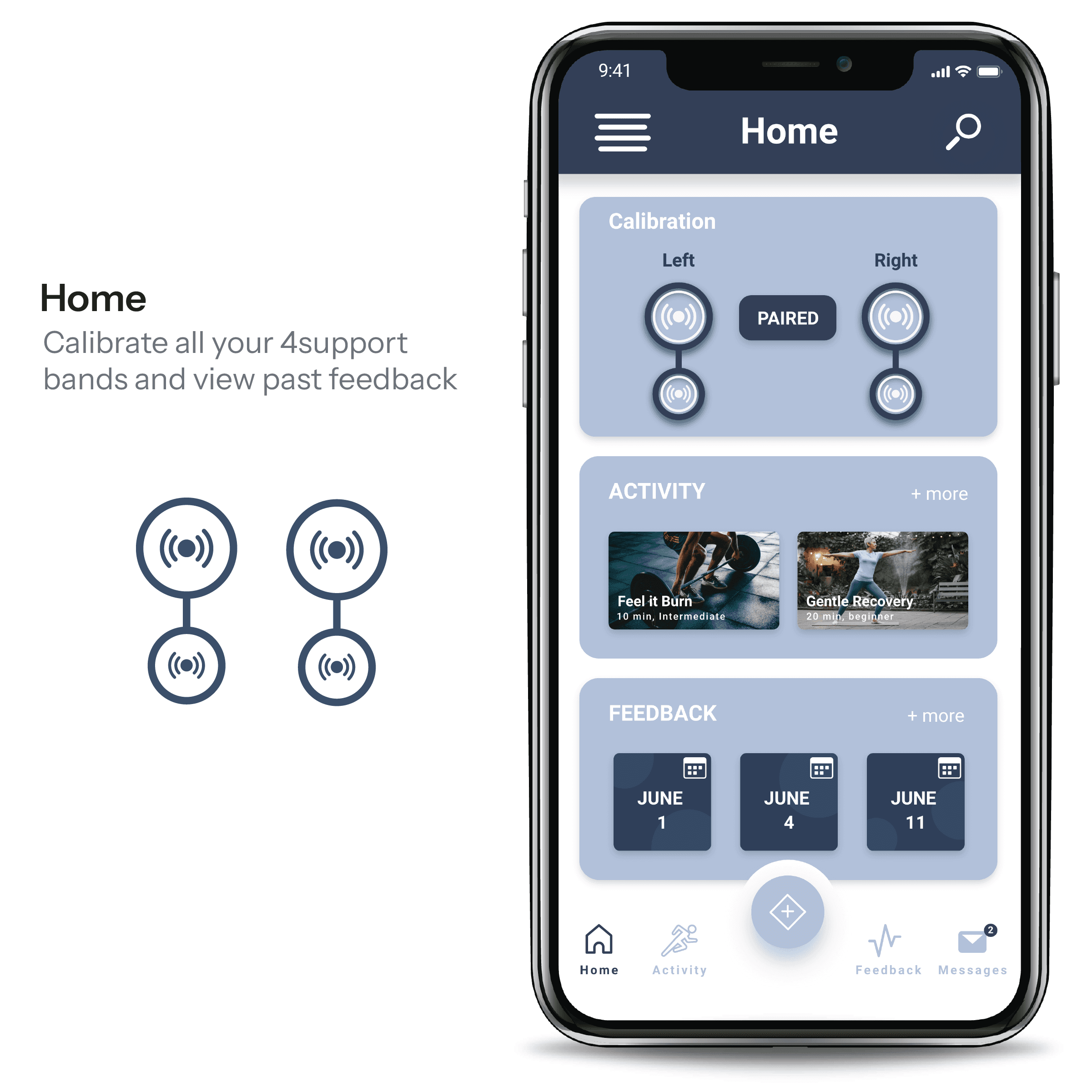
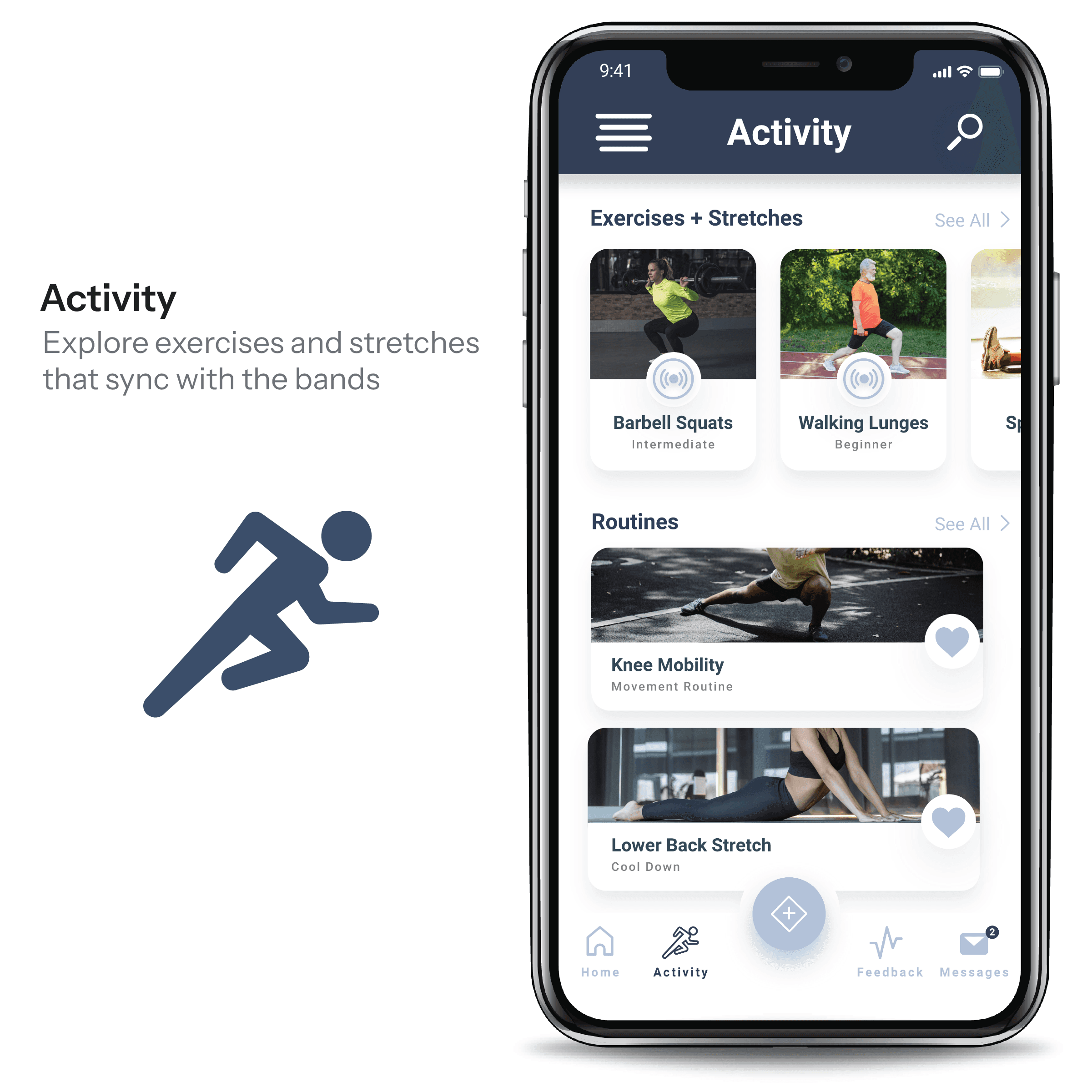
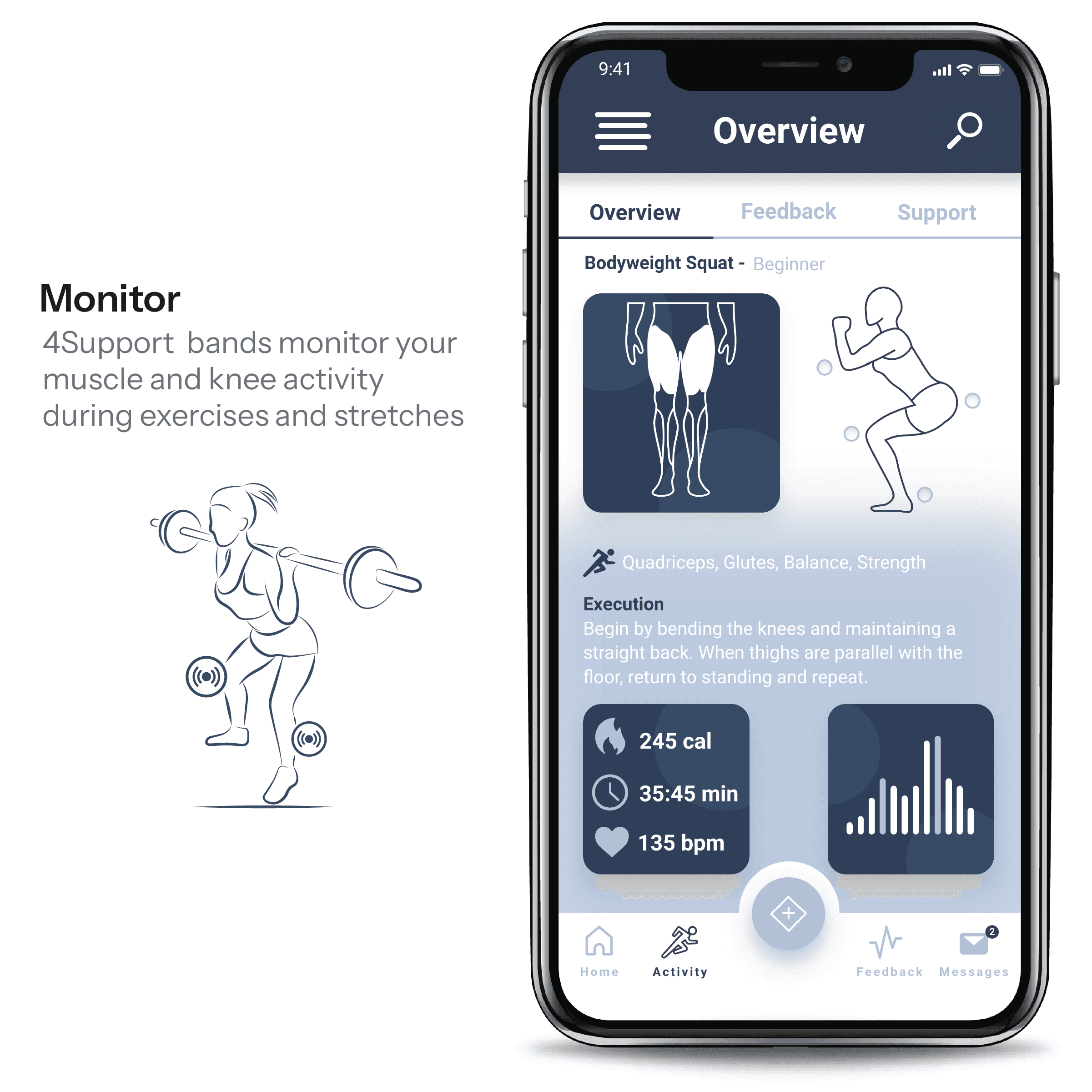
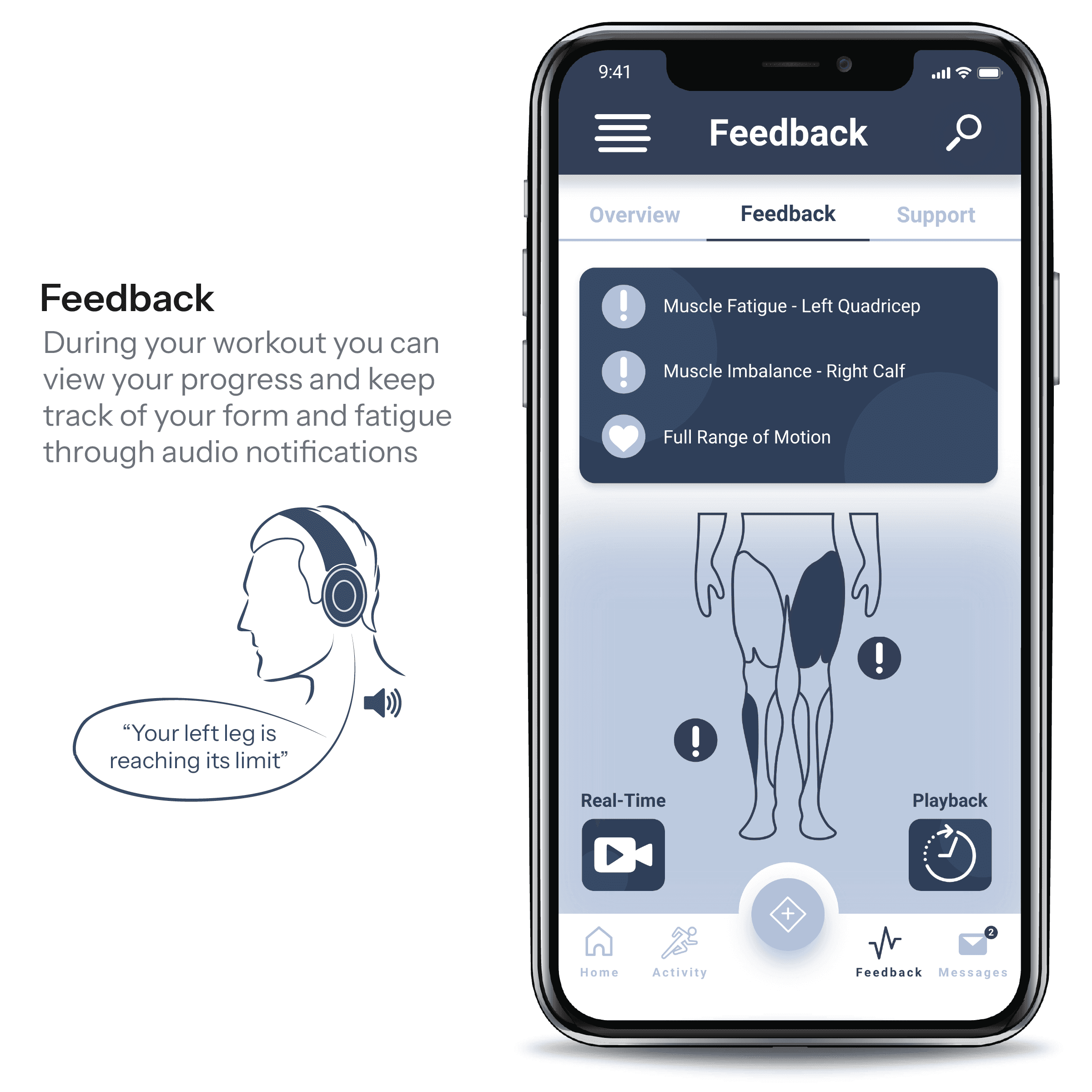
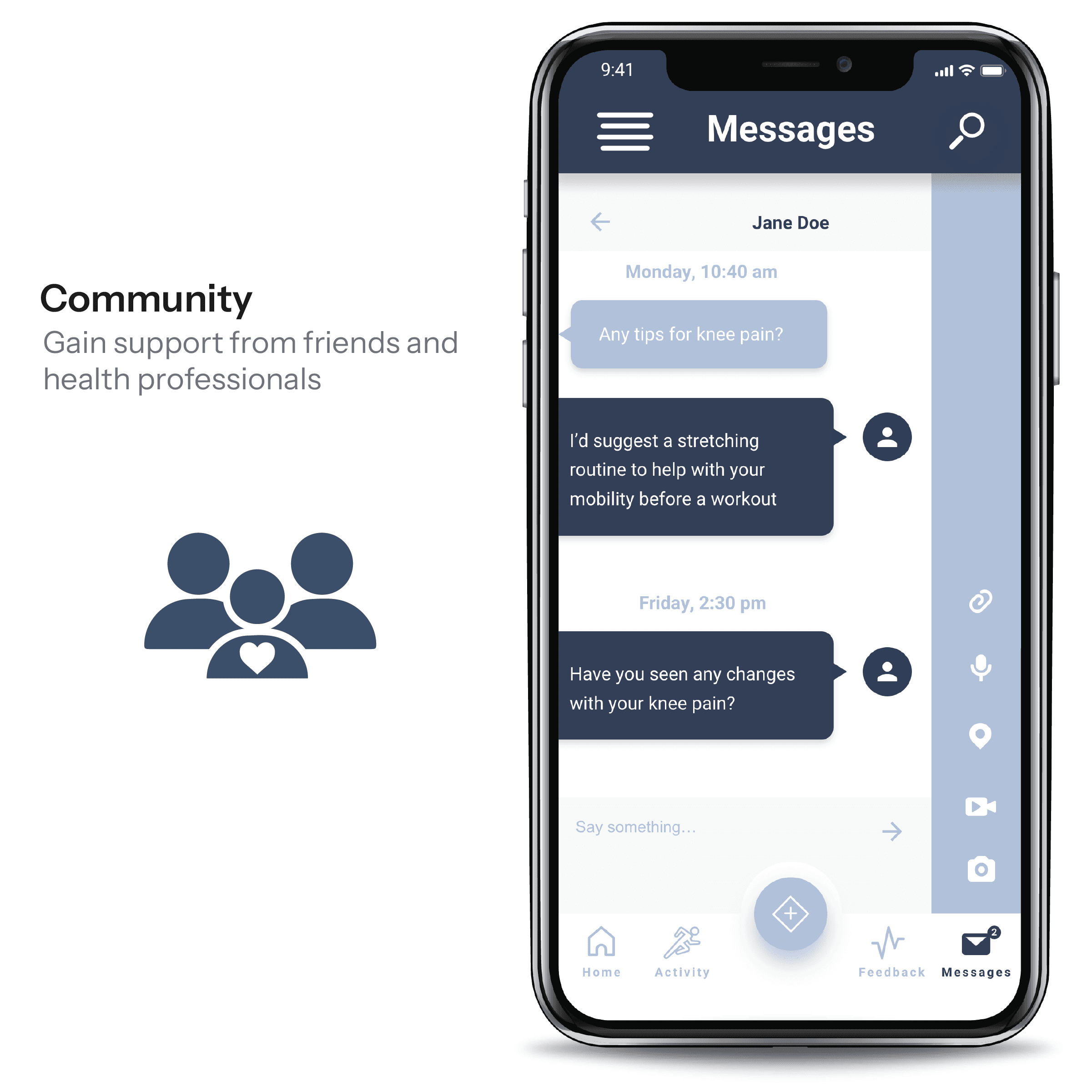
The 4Support app translates live sensor data into clear, actionable feedback. During workouts, users receive real-time insights on muscle engagement, fatigue levels, and joint alignment to help maintain proper form. After each session, performance summaries highlight imbalances and progress over time.
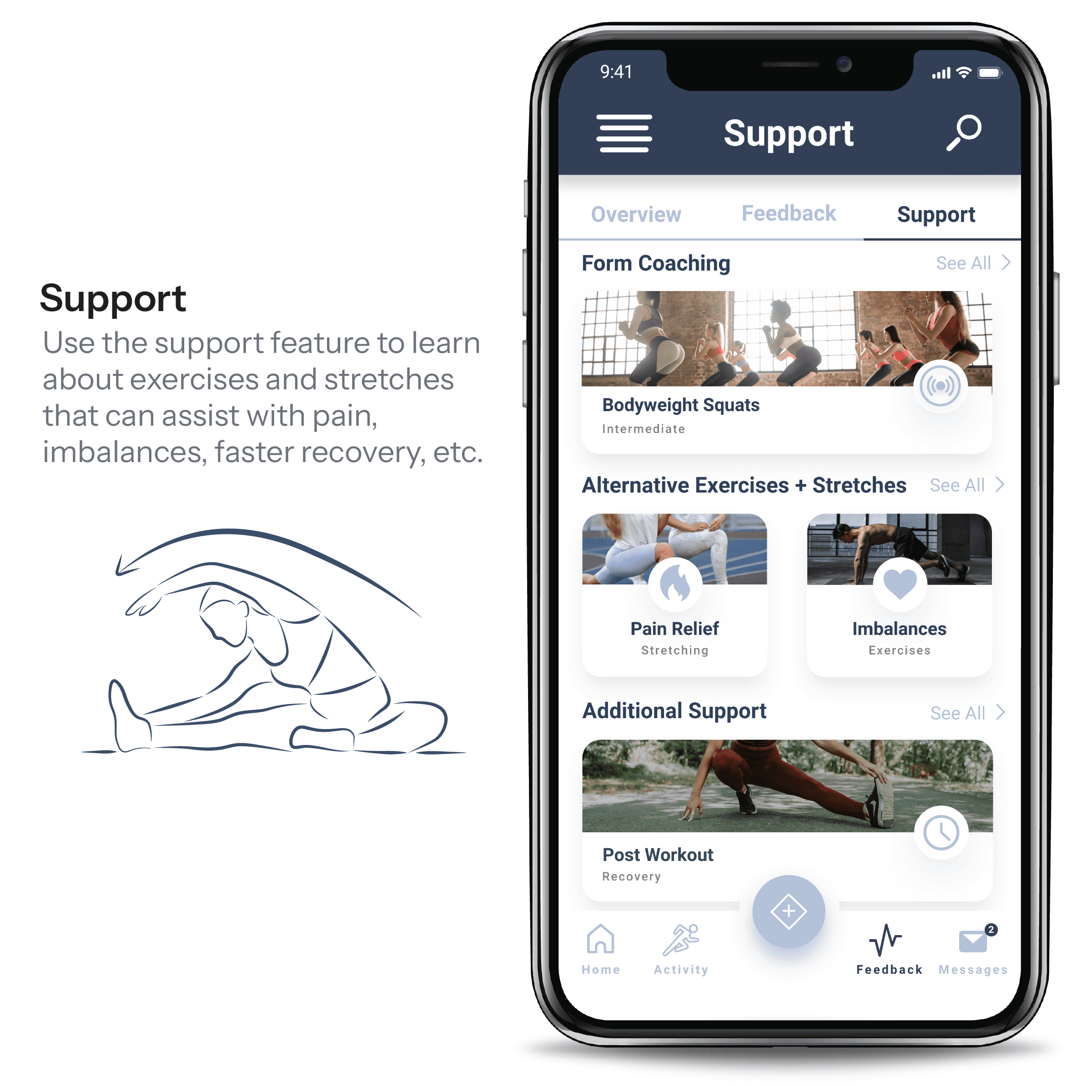
Beyond individual tracking, the app creates a connected training experience by allowing users to share results, receive coaching insights, and learn from peers and professionals. Together with the hardware, the app completes the system, turning biomechanical data into confident, informed movement.
The 4Support app transforms live sensor data into actionable guidance.
Users receive real-time feedback on muscle engagement, fatigue, and form, along with post-workout summaries that track progress over time.
By connecting users with peers and professionals, the app extends support beyond the workout making strength training smarter and more confident.
Key Takeaways
Reflections & Next Steps
While 4Support successfully integrates sensing technology, real-time feedback, and ergonomic design, there is clear opportunity to refine the system further. Future iterations could focus on reducing overall bulk, creating a slimmer profile, and improving adaptability across a wider range of leg shapes and sizes. Simplifying the donning process would also make the experience more intuitive and seamless.
Advancing adjustability and personalizing sensor placement to better align with individual anatomy would improve both comfort and signal reliability. These refinements would help the wearable feel less like equipment and more like a natural extension of movement.
4Support integrates sensing, feedback, and ergonomics effectively, but future refinements could enhance comfort and discretion.
Slimming the bands, improving fit across diverse leg shapes, and simplifying the donning process would make the system feel more seamless.
Further optimizing adjustability and sensor placement would improve reliability while maintaining comfort during all types of movement.
Cross-Disciplinary Insights
Through research, prototyping, and testing, it became evident that this technology extends far beyond its initial focus on older adults and strength training. Athletes across disciplines including skiing, basketball, running, and other high-demand sports could benefit from real-time lower-body tracking and muscle activation feedback.
By delivering precise insight into movement patterns, fatigue progression, and muscular compensation, 4Support has the potential to help athletes train more intelligently, reduce injury risk, and sustain peak performance over time. The system positions biomechanical awareness not as a reactive tool, but as a proactive advantage.
Testing revealed that this technology extends beyond older adults and strength training.
Athletes in skiing, basketball, running, and other high-impact sports could benefit from real-time lower-body tracking and muscle activation feedback.
By identifying fatigue, movement inefficiencies, and compensation patterns early, 4Support enables smarter training, reduced injury risk, and longer-term performance sustainability.